
Crumb Rubber Market Trends: EPR Policies and Virgin-Rubber Costs Accelerate Recycling
Why the Next Crumb Rubber Opportunity May Come From Infrastructure
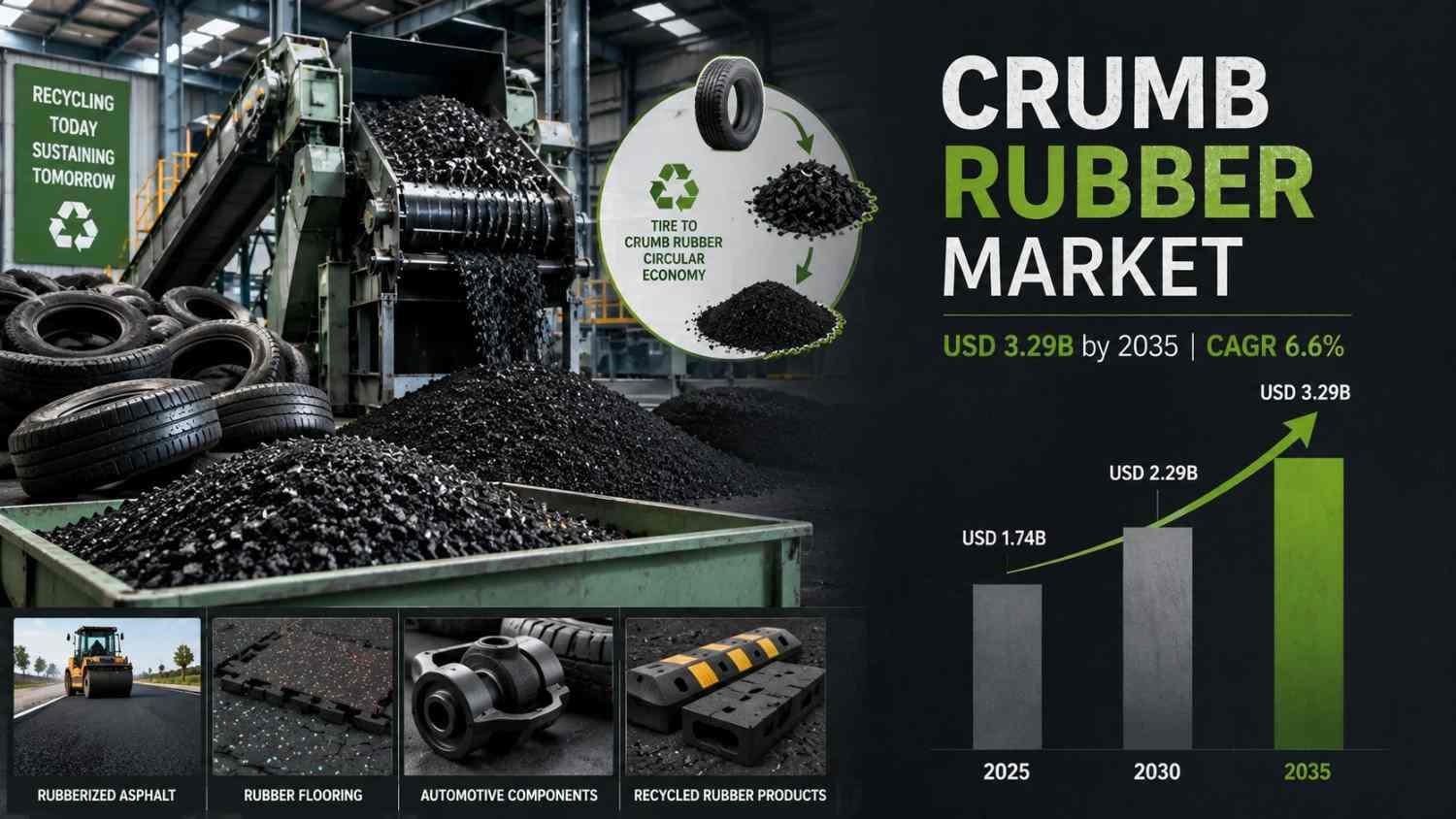
Road construction, building materials and industrial products are giving recycled tire rubber a new commercial role. The Crumb Rubber Market Trends point toward an industry expanding from traditional tire-recycling activities into broader circular manufacturing. Valued at USD 1.74 billion in 2025, the market is projected to reach USD 3.29 billion by 2035, growing at a CAGR of 6.6% during 2026–2035. The major question is whether infrastructure and industrial applications can absorb enough recovered material to support the next phase of capacity expansion.
Infrastructure Can Change the Scale of Demand
One of the limitations of recycling markets is that collection can outpace demand. If recovered material has only a narrow set of applications, processors can struggle to sell output consistently.
Infrastructure offers a potential solution because road projects consume materials in large quantities.
Rubberized asphalt is particularly relevant because it connects tire recovery with public and private infrastructure investment. Where specifications allow recycled rubber to be used, road programs can create a predictable outlet for material generated by tire recyclers.
This also changes the business logic for waste tires. Instead of viewing collection as the final objective, recycling operators can build their economics around supplying a defined industrial application.
The Industry Is Being Pushed by Two Different Cost Pressures
Crumb rubber is benefiting from both regulatory and economic pressure.
EPR mandates increase attention on the cost of end-of-life tire management. At the same time, fluctuations in virgin-rubber costs can make recycled inputs more attractive in applications where performance requirements permit their use.
These forces do not guarantee adoption. Buyers still compare recycled rubber against alternative materials based on price, quality and reliability.
The opportunity is strongest when recycled rubber can provide a combination of acceptable performance, predictable supply and a measurable environmental benefit.
Devulcanization Could Redefine Material Value
The distinction between ordinary crumb rubber and upgraded recovered rubber is becoming increasingly important.
Mechanical processing produces particles suitable for many applications, but vulcanized rubber retains its cross-linked structure. Devulcanization seeks to modify that structure, potentially allowing recovered rubber to participate more effectively in new rubber formulations.
The commercial promise is significant because higher-value applications could improve the economics of recycling.
Yet technology developers face a difficult balance. A process must improve material properties without adding excessive energy consumption, equipment costs or complexity. It must also operate consistently at industrial scale.
For this reason, the next stage of competition will likely involve process efficiency and material quality rather than simply the number of tires processed.
Flooring and Molded Products Provide Market Diversification
Not every opportunity requires advanced material regeneration.
Rubber flooring can use recycled rubber where resilience and impact absorption are valued. Such products can serve industrial facilities, recreational spaces and other environments where durability matters.
Molded goods provide another outlet. Manufacturers can select recovered rubber for components where recycled content is technically suitable and cost-effective.
These applications are commercially important because they reduce the industry's reliance on one large demand source. A diversified customer base can help recyclers manage changes in road construction, automotive demand or commodity pricing.
Collection Networks Are a Hidden Competitive Advantage
The economics of crumb rubber begin before a tire reaches the recycling plant.
Waste tires are distributed across a broad network of consumers, repair facilities, vehicle fleets and commercial operators. Bringing them together requires collection systems that are reliable enough to support industrial-scale processing.
Transportation costs add another layer. Tires are bulky relative to their processed form, so moving them long distances before shredding can undermine profitability.
This gives location and collection partnerships strategic importance. A processor with dependable access to large feedstock pools may enjoy an advantage even if its technology is not radically different from competitors.
Sustainability Is Changing Purchasing Decisions
Recycled content is becoming more relevant to manufacturers and building-material buyers, but sustainability alone does not guarantee commercial success.
Customers still require products to perform. Flooring must withstand use, asphalt systems must meet engineering requirements, and molded components must maintain necessary physical properties.
This means the strongest sustainability proposition is one supported by measurable performance.
Companies that can demonstrate consistent recycled content, material quality and efficient processing can make circularity part of the purchasing decision rather than treating it as a marketing claim.
Regional Dynamics Will Shape Investment
North America has the combination of automotive activity and established recycling infrastructure needed to support market development. Europe benefits from strong circular-economy policies and producer-responsibility frameworks.
Asia-Pacific has the potential to become increasingly important as vehicle populations, industrial production and construction activity expand. However, investment needs to address the entire chain from collection through processing to end-use markets.
In regions where collection remains fragmented, establishing organized feedstock systems may be a more important first step than adding processing capacity.
Competitive Positioning Is Becoming More Specialized
The market includes companies such as Liberty Tire Recycling LLC, Genan Holding A/S, Lehigh Technologies, GRP Ltd., J. Allcock & Sons Ltd. and Emanuel Tire LLC.
Competitive differentiation can occur through feedstock access, processing technology, product quality or customer specialization. A company focused on large-volume commodity crumb may have a different strategy from one developing specialized recycled-rubber grades.
As demand becomes more sophisticated, relationships with asphalt producers, flooring manufacturers and industrial customers can become strategically valuable.
The Opportunity Is to Capture More Value From Every Tire
The most attractive business models may increasingly focus on yield and value rather than simple tonnage.
Better separation can recover more useful material. Improved processing can create more consistent grades. Devulcanization can potentially open new applications. Stronger downstream relationships can improve demand visibility.
This suggests that the future competitive advantage will come from treating tire recycling as a materials business.
What Could Reshape the Market by 2035
The projected 6.6% CAGR indicates a market with meaningful expansion potential, but the trajectory will depend on several practical developments.
EPR implementation could increase feedstock availability. Road programs could create large-volume demand. Devulcanization could raise the value of recovered material. Green-building specifications could create additional applications.
If these developments reinforce each other, crumb rubber can become an increasingly important bridge between waste management and industrial manufacturing.
Another Trending Topics
Industrial Water Storage Tanks Market
Inkjet Colorants Market
Inkjet Paper Films Market

 English
 Arabic
 French
 Spanish
 Portuguese
 Deutsch
 Turkish
 Dutch
Dutch
 Italiano
 Russian
 Portuguese (Brazil)
 Greek
Greek