
Solar Panel Coatings Market Outlook: Self-Cleaning and Anti-Soiling Technologies Create New Demand
Solar Panel Coatings Are Moving Into the Asset-Management Conversation
The economics of solar power are increasingly being shaped by what happens after a panel leaves the factory. A photovoltaic module may have advanced cells and high-quality electrical components, but its real-world performance still depends on how effectively its surface handles sunlight, dust, water and environmental wear. That is creating momentum for the Solar Panel Coatings Market Growth, which was valued at USD 5.13 billion in 2024 and reached USD 6.5 billion in 2025. The market is projected to reach USD 69.3 billion by 2035, expanding at a CAGR of 26.7% during 2025–2035.
The important shift is that coatings are increasingly being viewed as part of lifecycle performance rather than merely as protective finishes.
Solar Assets Need More Than Higher Conversion Efficiency
Much of the solar industry's innovation has historically focused on improving the ability of photovoltaic cells to convert sunlight into electricity. That remains important, but module performance in the field is affected by external conditions.
Dust can cover the surface. Rainwater can leave deposits. Wind can carry abrasive particles. Repeated cleaning can create its own wear. In each case, the panel's ability to receive and transmit sunlight can be affected.
Coatings offer a way to address these issues without fundamentally changing the photovoltaic cell.
This makes them attractive because they can potentially complement improvements in cell architecture, module design and power electronics.
Why the Maintenance Equation Is Changing
Maintenance decisions are becoming more important as solar installations scale.
For small systems, cleaning may be occasional and inexpensive. For a large solar project, thousands of modules may need attention across a wide area. Labor, equipment and water can turn cleaning into a recurring operating expense.
A self-cleaning or anti-soiling coating can potentially alter this maintenance equation. Rather than eliminating maintenance, it can aim to extend the interval between cleaning activities or make contamination easier to remove.
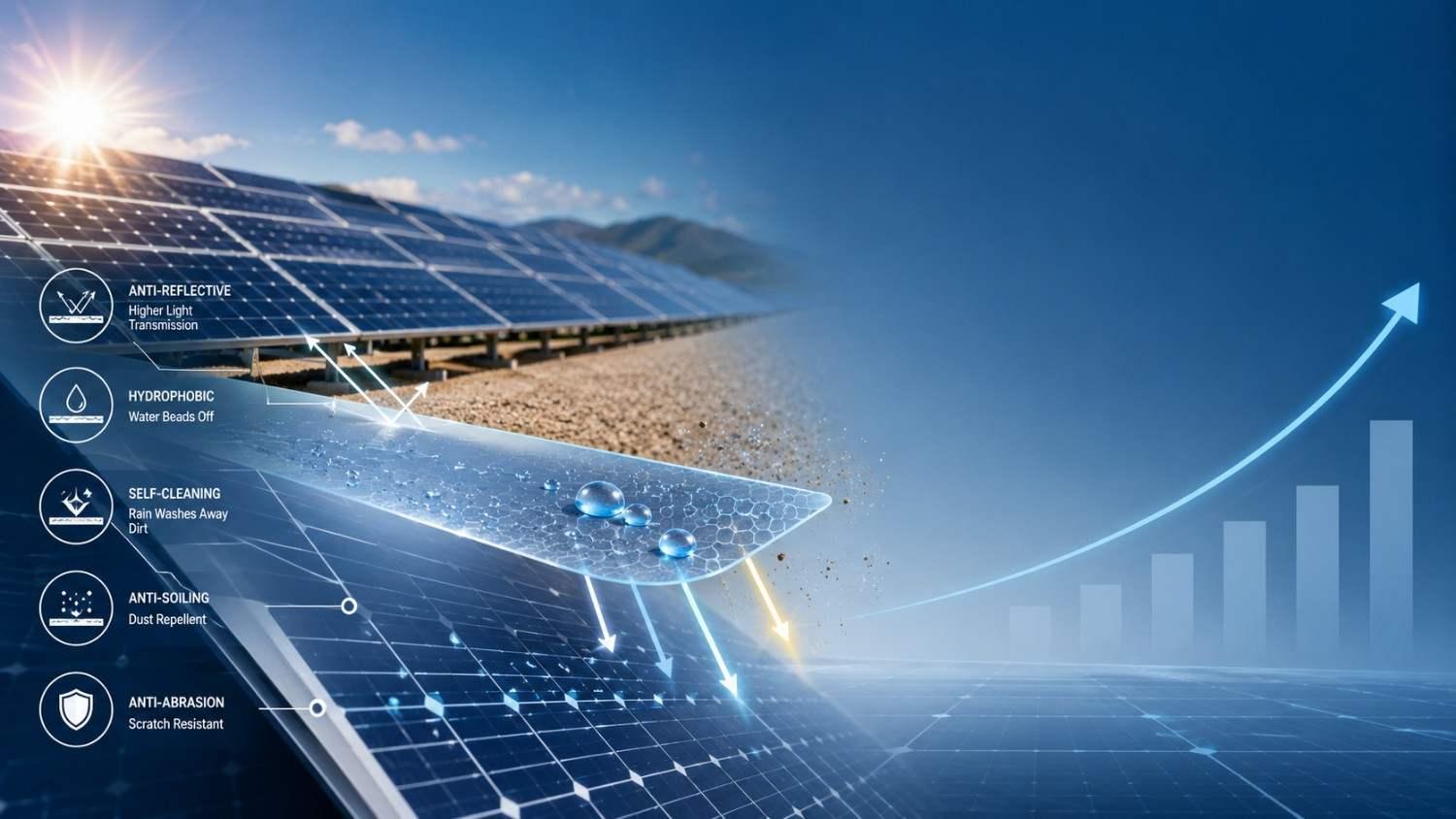
Hydrophobic coatings contribute by modifying surface-water behavior, while anti-soiling technologies focus more directly on contamination resistance.
The business case becomes stronger in areas where water is scarce or cleaning access is difficult.
Optical Performance Is Another Important Opportunity
Not all coating technologies are designed primarily to keep panels clean.
Anti-reflective coatings address a different issue: light that reaches the panel but is reflected rather than transmitted toward the photovoltaic cell. Improving optical transmission can potentially support energy generation without increasing the physical size of the module.
This illustrates why the market contains several distinct technology pathways.
Self-cleaning and hydrophobic products address maintenance and contamination. Anti-reflective formulations focus on optical efficiency. Anti-abrasion coatings focus on durability.
The next stage of competition could involve combining these characteristics into multifunctional surfaces.
The Technology Challenge Is Maintaining Performance for Years
Solar modules are exposed to the environment for long periods. A coating therefore needs to do more than perform well when initially applied.
Ultraviolet exposure, temperature changes, humidity and cleaning operations can gradually affect surface properties. A coating that loses hydrophobicity or transparency too quickly may not provide sufficient lifecycle value.
Testing and validation consequently become central to commercial adoption.
Manufacturers also need to consider the coating's interaction with the underlying glass and other module components. Adhesion, transparency and application consistency can all influence final performance.
The ability to integrate coatings into high-volume production will become especially important as adoption grows.
Sustainability Has Two Sides
The sustainability opportunity in solar coatings is real, but it is not automatic.
A coating that reduces cleaning frequency may lower water use. A durable surface treatment may help maintain module performance for longer. Both can support more efficient use of resources.
However, the formulation itself has an environmental footprint. Raw-material extraction, chemical processing, manufacturing energy and eventual disposal all need consideration.
This creates a more demanding sustainability standard. Suppliers will increasingly need to demonstrate that environmental benefits exist across the product lifecycle rather than only at the point of application.
Solar Expansion Creates Multiple Application Windows
Residential solar can benefit from reduced maintenance and improved long-term surface performance. Homeowners typically value systems that can operate reliably without frequent intervention.
Commercial facilities have a stronger operational focus. Warehouses, factories and office buildings can use rooftop solar to offset energy costs, making predictable output important.
Utility-scale projects represent the largest opportunity for performance optimization because small differences can be multiplied across extensive module fields.
Agricultural applications may benefit from coatings that address contamination in dusty or particulate-heavy environments.
Automotive solar represents a more specialized opportunity where coatings must satisfy demanding requirements for appearance, transparency and durability.
Geography Will Determine Which Coating Features Matter Most
Asia-Pacific combines manufacturing concentration and strong solar deployment, making it an important market for coating suppliers. Integration into module manufacturing could provide a major route to scale.
North America offers a diverse combination of residential, commercial and utility-scale projects. Long-term asset economics can create demand for technologies that reduce maintenance and preserve performance.
Europe's emphasis on renewable energy and environmental performance can support interest in advanced coatings with lower environmental impacts.
The Rest of the World includes markets where climate conditions can create especially strong use cases. High dust exposure and water limitations can increase the value of anti-soiling and self-cleaning solutions.
Competitive Positioning Will Depend on Application Knowledge
The competitive landscape includes Saint-Gobain, 3M, Dow, BASF, Henkel and Solvay. These organizations bring established capabilities in chemicals, specialty materials and industrial-scale manufacturing.
Their challenge is to translate those capabilities into photovoltaic-specific value.
A coating manufacturer that understands module production, field conditions and lifecycle economics can potentially differentiate more effectively than a supplier competing only on formulation cost.
The market may consequently favor companies that combine chemistry with application engineering and field validation.
New Business Models Could Follow the Technology
As coating adoption expands, the market could move toward more service-oriented approaches.
Solar operators may become interested in monitoring coating performance alongside panel output. This could make it possible to compare energy yield, contamination levels and cleaning frequency across coated and uncoated systems.
Such data could help establish stronger return-on-investment cases and reduce uncertainty for project developers.
It could also encourage coating suppliers to sell performance solutions rather than treating the product purely as a chemical input.
The Decade Ahead Will Test the Real Value of Coatings
The projected increase to USD 69.3 billion by 2035 points to a market with substantial room for expansion. But the industry's most important milestone will be proving that coatings deliver consistent value under real operating conditions.
If they can reduce maintenance, protect surfaces and preserve optical performance at a commercially acceptable cost, they could become an increasingly standard component of photovoltaic engineering.
Market Outlook
Solar panel coatings are entering a period in which materials science is becoming closely connected with asset economics. The strongest demand will come from situations where surface conditions materially affect energy production or operating costs.
That makes the future less about selling a protective layer and more about solving a measurable performance problem.
The companies that can demonstrate that connection convincingly will have the strongest opportunity to turn coatings from an optional enhancement into an established part of solar-system design.
Another Trending Topics
 Dutch
Dutch
 English
 Arabic
 French
 Spanish
 Portuguese
 Deutsch
 Turkish
 Italiano
 Russian
 Romaian
 Portuguese (Brazil)
 Greek
Greek