
Global Smart Factory Market Forecast to Hit USD 508.7 Billion by 2036
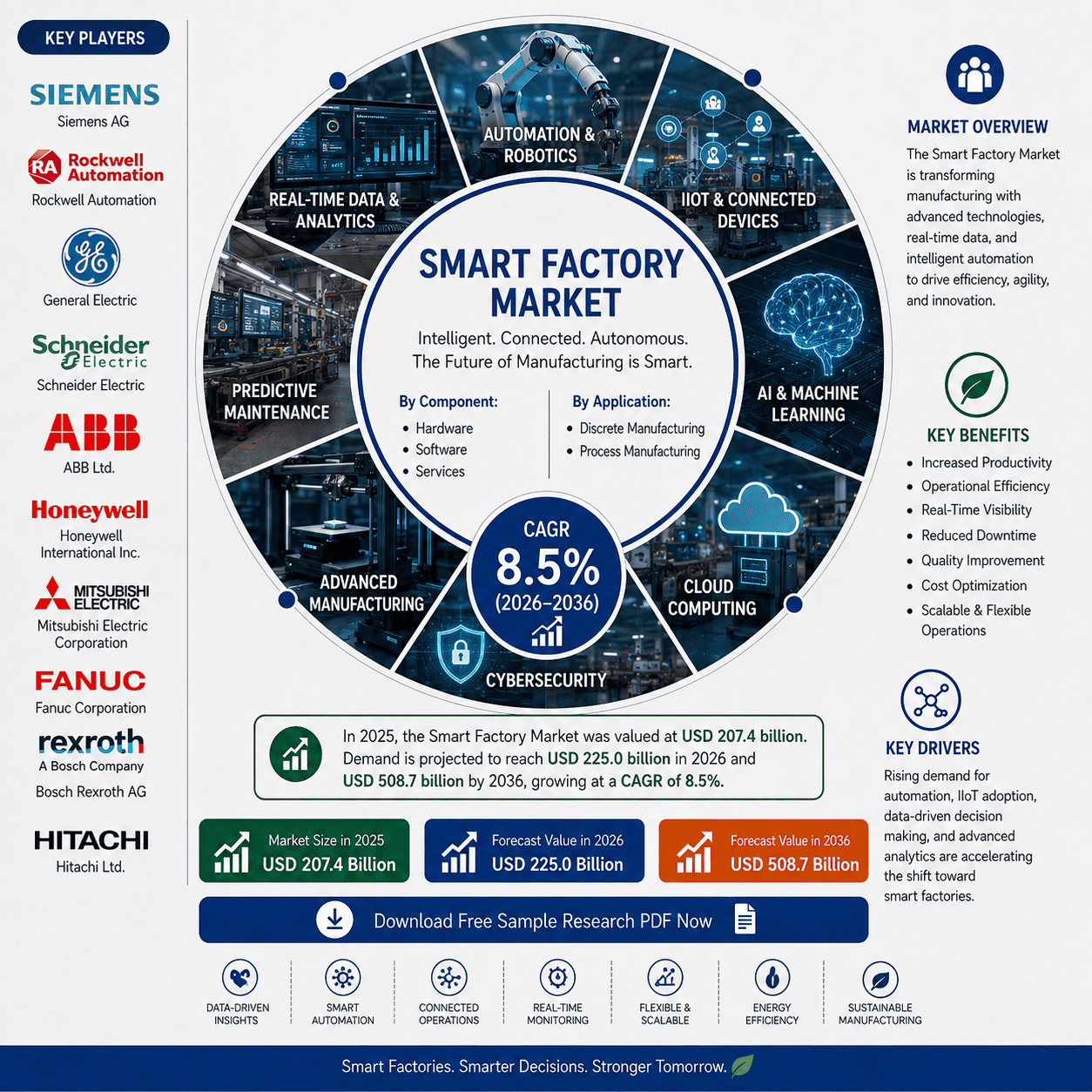
August 12, 2026 — The global smart factory market is estimated at USD 225.0 billion in 2026 and is projected to reach USD 508.7 billion by 2036, expanding at a CAGR of 8.5% during 2026–2036, according to Fact.MR analysis.
Manufacturers are investing in smart factory systems because production is becoming more connected and automated. Industrial IoT, AI, robotics, digital twins, and automated quality systems are gaining use across automotive, electronics, food, and other manufacturing industries. Rising labor costs also encourage automation. Nearshoring is creating demand for highly automated production facilities. Government digitalization programs are adding further support. At the same time, high upfront investment, OT cybersecurity risks, and legacy factory integration remain key restraints.
Third-Party Evidence Points to Faster Automation
Several dated external statistics cited by Fact.MR support the market outlook. The International Federation of Robotics, in its September 2024 World Robotics Report 2024, reported about 590,000 industrial robot installations in 2023, with automotive and electronics accounting for about 65% of installations.
The Ministry of Industry and Information Technology of China, in September 2024, outlined a 2024–2026 intelligent manufacturing plan targeting 10,000 smart factories and 100 lighthouse factories by 2026. The program also provides subsidies covering up to 30% of automation and industrial IoT equipment investment, according to the Fact.MR report.
The U.S. Department of Commerce, in November 2024, cited USD 52 billion in CHIPS and Science Act support for semiconductor manufacturing expansion. Fact.MR states that new fabs from Intel, Samsung, and TSMC must include advanced automation and smart manufacturing systems.
Get detailed market forecasts, competitive benchmarking, and pricing trends: https://www.factmr.com/connectus/sample?flag=S&rep_id=14553
Key Numbers
- Smart factory market value, 2025:USD 207.4 billion
- Estimated market value, 2026:USD 225.0 billion
- Forecast market value, 2036:USD 508.7 billion
- CAGR, 2026–2036:5%
- Absolute dollar opportunity, 2026–2036:USD 283.7 billion
- Hardware share, 2026:About 70%
- Discrete industry share, 2026:About 61%
Fact.MR reports that the market was valued at USD 207.4 billion in 2025 and expects an absolute dollar opportunity of USD 283.7 billion between 2026 and 2036.
Segment Breakdown
By component: Hardware is expected to lead with about 70% share in 2026. Sensors, robotics, programmable logic controllers, and edge infrastructure form the base needed for smart factory software platforms.
By end user: Discrete industries are projected to account for about 61% share in 2026. Automotive and electronics manufacturers are major sources of automation demand.
By industry vertical: Automotive leads the industry vertical segment. Fact.MR links this position to high automation needs in EV and battery production.
By technology direction: The market is gradually moving beyond hardware-led investment toward software and services. AI analytics, digital twins, and manufacturing execution systems are creating recurring revenue opportunities.
Country Growth Outlook
- China:2% CAGR (2026–2036)
- India:8% CAGR (2026–2036)
- South Korea:1% CAGR (2026–2036)
- Germany:6% CAGR (2026–2036)
- United States:0% CAGR (2026–2036)
- Japan:5% CAGR (2026–2036)
China is projected to post the fastest growth at 10.2% CAGR, followed by India at 9.8% and South Korea at 9.1%, according to Fact.MR. Germany is forecast at 8.6%, the United States at 8.0%, Japan at 7.5%, and the United Kingdom at 6.8%.
Competitive Landscape
The smart factory market has moderate platform-level concentration but remains fragmented across technology components. Siemens AG, ABB Ltd., Rockwell Automation, Schneider Electric, General Electric, Honeywell International, Mitsubishi Electric, Fanuc, Bosch Rexroth, and Hitachi are among the key companies profiled by Fact.MR.
Fact.MR does not publish individual market-share percentages for these companies on the cited page, so no company share is assigned here. Siemens is positioned around its Xcelerator platform, while ABB benefits from robotics and system integration. Rockwell Automation uses its North American installed base and Plex MES platform. Fanuc, Mitsubishi Electric, and Bosch Rexroth compete in areas including robotics, industrial IoT, and motion control.
Analyst commentary: Shambhu Nath Jha, Principal Consultant at Fact.MR, states that the report helps CXOs understand how “AI-driven manufacturing intelligence and digital twin platforms are transforming factory automation and production optimisation.”
FAQ
How large is the smart factory market in 2026?
Fact.MR estimates the market at USD 225.0 billion in 2026.
What will the smart factory market be worth in 2036?
The market is projected to reach USD 508.7 billion by 2036.
What is the smart factory market CAGR from 2026 to 2036?
Fact.MR projects an 8.5% CAGR.
Which smart factory segment has the largest share?
Hardware holds about 70% share in 2026, while discrete industries hold about 61%.
Which country has the fastest smart factory market growth?
China leads the listed countries with a projected 10.2% CAGR through 2036.
About Fact.MR
Fact.MR is a market research and advisory firm providing industry forecasts, market intelligence, competitive analysis, and strategic insights for businesses and decision-makers.
 Dutch
Dutch
 English
 Arabic
 French
 Spanish
 Portuguese
 Deutsch
 Turkish
 Italiano
 Russian
 Romaian
 Portuguese (Brazil)
 Greek
Greek