
Moldpartsfactory Insights on Mold Wear Block Materials for Durability
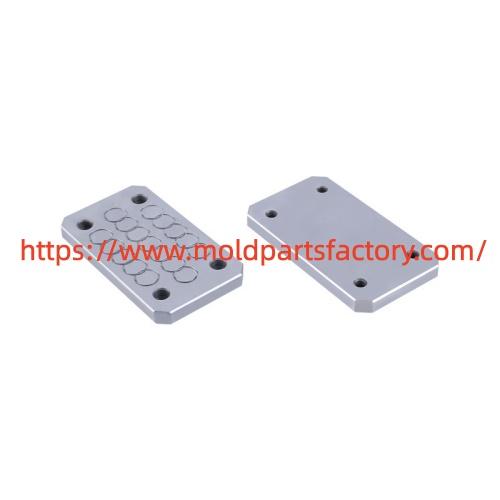
Mold Wear Block selection plays a key role when tools face repeated sliding contact under high production volumes. The right material choice helps the protective element resist friction heat and surface degradation so the overall tool continues to deliver consistent part quality across many cycles. Different alloys and composites address varying levels of contact stress temperature and maintenance access. Matching the grade to the application reduces unexpected downtime and keeps the forming process stable.
Hardened tool steels remain a frequent option for general high volume work. Grades with elevated carbon and chromium content achieve high surface hardness after heat treatment while retaining enough toughness to handle impact during opening and closing. These steels suit moderate to elevated contact pressures on external slides and internal guiding surfaces. Proper surface finishing after hardening further lowers the friction coefficient and slows the rate of material loss. Regular inspection of contact faces allows early detection of scoring so the element can be replaced before damage spreads to the surrounding plates.
Tungsten carbide inserts serve applications where abrasion reaches higher intensity. The extreme hardness of carbide resists particle embedding and micro cutting that occur when filled resins or high glass content materials pass nearby. Carbide elements often appear in areas of continuous linear motion under heavy load. Because carbide is more brittle than steel the supporting structure must provide rigid backing and precise alignment to avoid chipping. Mounting methods that allow straightforward removal help keep service times short when replacement eventually becomes necessary.
Bronze based and other self lubricating alloys offer another path for environments where external lubrication is limited or undesirable. These materials release small amounts of solid lubricant during operation which reduces the coefficient of friction and limits heat buildup. They work well in lighter duty or moderate cycle tools where the contact pressure stays within moderate ranges. The softer nature of bronze compared with steel means the mating surface experiences less aggressive scoring yet the element itself will show dimensional change sooner. Designers often specify these grades when quiet operation and reduced maintenance access are priorities.
Surface coatings applied to steel substrates combine the toughness of the base metal with a thin hard outer layer. Common treatments include nitriding physical vapor deposition films or thermal spray layers that raise surface hardness without changing the bulk properties of the insert. Coatings can extend service intervals in high cycle settings while keeping material costs lower than solid carbide. Coating thickness uniformity and adhesion quality influence how long the layer remains intact under repeated sliding. Periodic evaluation of coating condition forms part of a practical maintenance plan.
Material selection also considers thermal expansion rates relative to the surrounding plates. Significant mismatch can alter clearances as the tool reaches operating temperature and may lead to binding or excessive play. Grades with expansion coefficients close to the parent steel help maintain intended fits. Heat treatment processes must be controlled so residual stresses do not cause distortion after the element is installed.
Production volume influences the economic balance. Higher shot counts justify investment in longer lasting grades because the cost of interrupted runs and part scrap quickly exceeds the price difference of the protective component. Lower volume tools may accept more economical steels that still provide adequate life for the planned campaign. In every case the chosen material should allow the insert to be replaced without major disassembly of the tool. Standardized mounting features and accessible fasteners support this goal.
Moldpartsfactory supplies a range of abrasion resistant inserts and related guiding components in multiple material grades. Engineers can review hardness data thermal properties and recommended applications to match the element to specific tool requirements. Coordination between material choice and overall tool layout helps the protective surfaces perform their function across the intended production period.
Visit https://www.moldpartsfactory.com/ to review available grades and discuss material options that align with your high volume tool needs.

 English
 Arabic
 French
 Spanish
 Portuguese
 Deutsch
 Turkish
 Dutch
Dutch
 Italiano
 Russian
 Portuguese (Brazil)
 Greek
Greek