
Complete Guide to BIS FMCS Certification for Foreign Manufacturers
Introduction
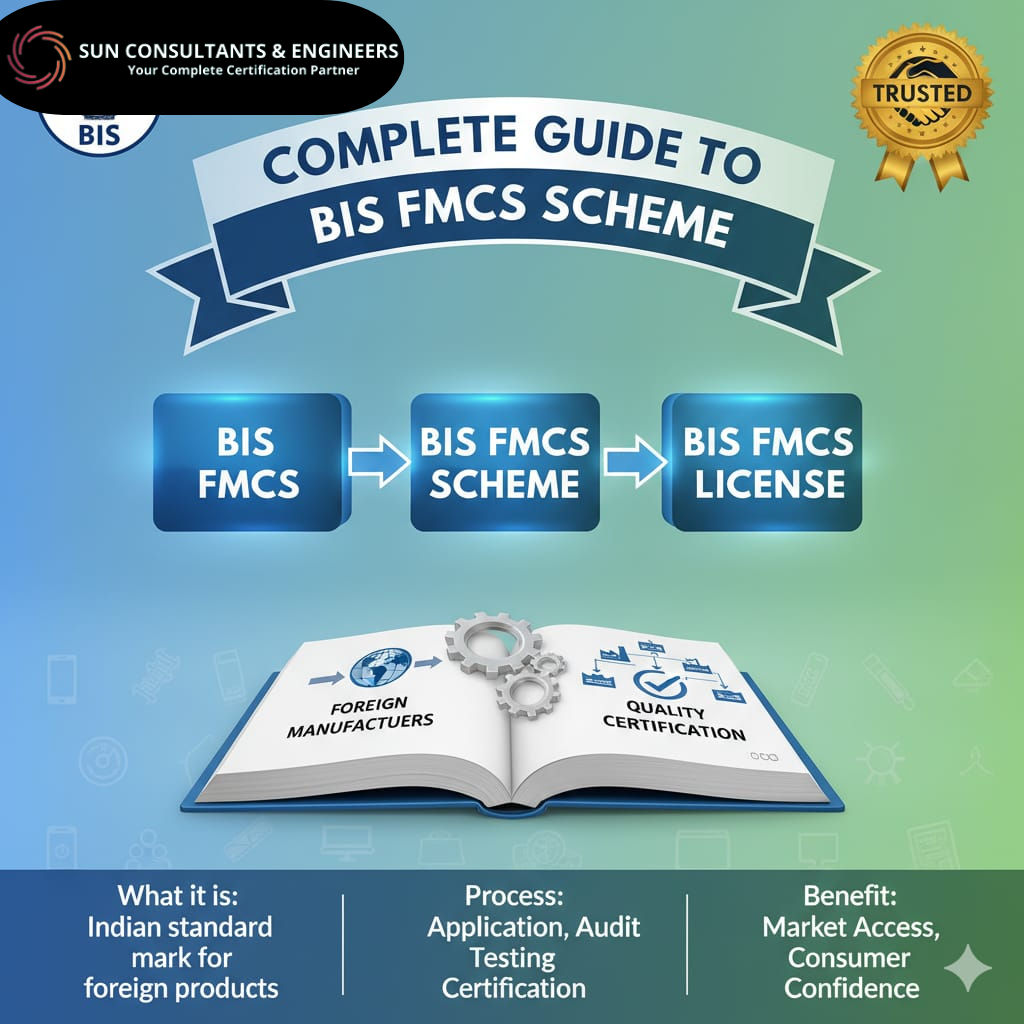
Expanding into the Indian market offers tremendous opportunities for foreign manufacturers, but it also requires compliance with India's quality and safety regulations. One of the most important requirements is obtaining a BIS FMCS Certification for products covered under mandatory Indian Standards. Through the Foreign Manufacturers Certification Scheme (FMCS), overseas manufacturers can secure a BIS FMCS Certificate that allows them to use the Standard Mark on eligible products and legally sell them in India. Whether you manufacture electrical equipment, construction materials, household products, or industrial goods, understanding the BIS License for Foreign Manufacturer process is essential for smooth market entry and regulatory compliance.
What is a BIS FMCS Certificate?
A BIS FMCS Certificate is an official approval issued by the Bureau of Indian Standards (BIS) under the Foreign Manufacturers Certification Scheme (FMCS). It authorizes eligible overseas manufacturers to use the BIS Standard Mark on products that comply with the applicable Indian Standards (IS). Unlike domestic certification schemes, FMCS is specifically designed for manufacturing facilities located outside India. The certification assures Indian authorities, distributors, and consumers that the products meet the same quality and safety standards as those manufactured within the country.
What is BIS FMCS Certification?
BIS FMCS Certification is the certification process through which foreign manufacturers obtain approval to export and sell regulated products in India. The process includes product testing, factory inspection, technical evaluation, and ongoing compliance monitoring. Manufacturers must demonstrate that their production processes consistently meet the requirements of the relevant Indian Standard. Once approved, they receive permission to use the BIS Standard Mark on certified products.
This certification is mandatory for many products notified under India's Quality Control Orders (QCOs).
What is a BIS License for Foreign Manufacturer?
A BIS License for Foreign Manufacturer is the licence granted to overseas manufacturing units after successfully completing the FMCS certification process.
The licence confirms that:
-
The product complies with the relevant Indian Standard.
-
The manufacturing facility has adequate quality control systems.
-
Product testing has been successfully completed.
-
BIS inspection requirements have been satisfied.
-
The manufacturer can legally export certified products to India.
Without this licence, foreign manufacturers cannot market many regulated products in India.
Who Needs a BIS Certificate for Foreign Manufacturer?
A BIS Certificate for Foreign Manufacturer is required for overseas manufacturers producing products covered under mandatory BIS certification.
Industries commonly requiring FMCS certification include:
-
Cement
-
Steel products
-
Electrical appliances
-
Pressure cookers
-
Household products
-
Chemicals
-
Automotive components
-
Building materials
-
Industrial equipment
-
Gas cylinders
-
Valves and fittings
Manufacturers should verify whether their product falls under the applicable Quality Control Order before exporting to India.
Benefits of BIS FMCS Certification
Obtaining BIS FMCS Certification provides several advantages for foreign manufacturers.
Legal Access to the Indian Market
Certified manufacturers can legally export regulated products to India.
Improved Customer Confidence
Products carrying the BIS Standard Mark are recognized for quality and safety.
Competitive Business Advantage
Certification enhances credibility among distributors, importers, and government buyers.
Regulatory Compliance
Meeting BIS requirements reduces the risk of shipment delays, product recalls, or regulatory action.
Enhanced Brand Reputation
Compliance with Indian Standards strengthens trust and supports long-term business growth.
Documents Required for FMCS Certification
Foreign manufacturers generally need the following documents:
-
Manufacturing licence
-
Company registration certificate
-
Factory layout
-
Product specifications
-
Product test reports
-
Quality control documents
-
Calibration records
-
Manufacturing process details
-
Trademark authorization (if applicable)
-
Details of the Authorized Indian Representative (AIR)
Providing accurate and complete documentation helps speed up the approval process.
BIS FMCS Certification Process
The certification process usually involves the following steps:
1. Product Identification
Identify the applicable Indian Standard (IS) and determine eligibility under FMCS.
2. Application Submission
Submit the application along with all required technical documents.
3. Product Testing
Products are tested in BIS-recognized laboratories to verify compliance.
4. Factory Inspection
BIS officials inspect the overseas manufacturing facility to evaluate production processes and quality control systems.
5. Technical Evaluation
BIS reviews inspection findings, laboratory reports, and submitted documentation.
6. Grant of Licence
Upon successful verification, the manufacturer receives the BIS License for Foreign Manufacturer.
Role of the Authorized Indian Representative (AIR)
Foreign manufacturers must appoint an Authorized Indian Representative (AIR) when required under BIS regulations.
The AIR acts as the official contact between the manufacturer and BIS by:
-
Coordinating certification activities
-
Managing documentation
-
Responding to BIS communications
-
Supporting compliance requirements
-
Assisting during licence renewals
Selecting an experienced AIR can significantly improve communication and certification efficiency.
Common Challenges During FMCS Certification
Manufacturers may encounter several challenges, including:
-
Incorrect product classification
-
Incomplete documentation
-
Delays in laboratory testing
-
Factory inspection observations
-
Non-compliance with Indian Standards
-
Delayed responses to BIS queries
Careful planning and proper documentation help minimize these issues.
Tips for Faster Approval
To streamline the certification process:
-
Identify the correct Indian Standard before applying.
-
Conduct pre-compliance testing.
-
Maintain a robust quality management system.
-
Prepare complete technical documentation.
-
Ensure manufacturing processes consistently meet Indian Standards.
-
Respond promptly to BIS observations and inspection findings.
These steps can reduce delays and improve the chances of successful certification.
Conclusion
Obtaining a BIS FMCS Certificate is essential for overseas manufacturers planning to enter the Indian market. Through BIS FMCS Certification, businesses demonstrate compliance with Indian quality and safety standards while earning the confidence of regulators, distributors, and consumers. A valid BIS License for Foreign Manufacturer not only enables legal market access but also strengthens brand reputation and long-term business success. Understanding the certification process, preparing complete documentation, and maintaining quality systems are key to achieving a smooth and successful certification journey.

 English
 Arabic
 Spanish
 Portuguese
 Deutsch
 Turkish
 Dutch
Dutch
 Italiano
 Russian
 Romaian
 Portuguese (Brazil)
 Greek
Greek