
FRCEM Question Bank for Effective Exam Preparation Guide
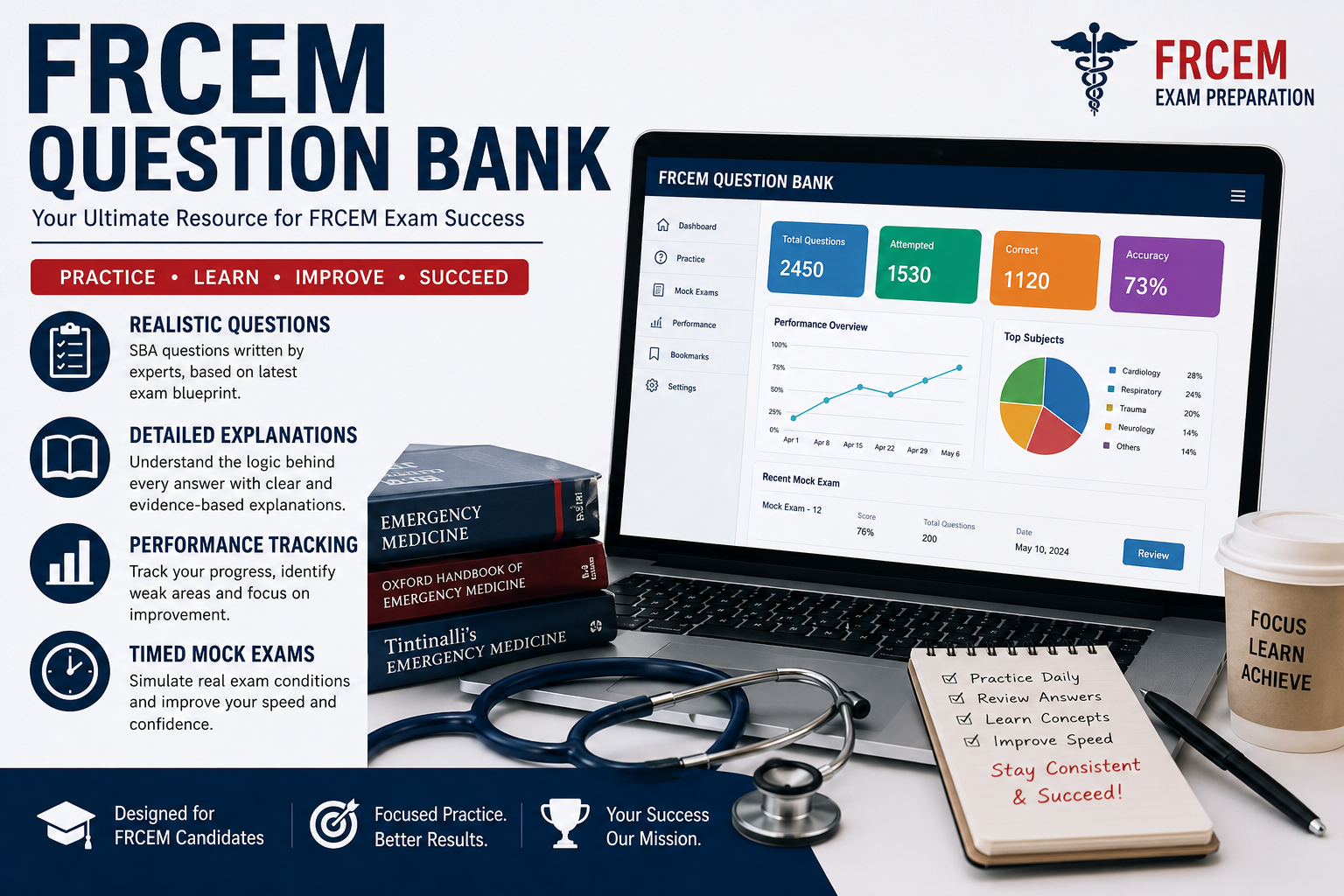
FRCEM Question Bank: Your Complete Guide to Exam Success
Preparing for the Fellowship of the Royal College of Emergency Medicine (FRCEM) exam is one of the biggest challenges for emergency medicine doctors. The exam requires a deep understanding of clinical knowledge, decision-making skills, and the ability to answer Single Best Answer (SBA) questions under strict time limits. One of the most effective resources for exam preparation is a FRCEM question bank.
A well-designed question bank helps candidates understand the exam pattern, identify weak areas, and build confidence before the actual examination. Whether you're preparing for the Intermediate SBA, Final SBA, or OSCE components, practicing high-quality questions is essential for success.
In this guide, you'll learn why an FRCEM question bank is important, how to choose the right one, and the best strategies to maximize your exam performance.
What Is an FRCEM Question Bank?
An FRCEM question bank is a collection of practice questions specifically designed to reflect the style and difficulty of the actual FRCEM examination. Most question banks include:
- Single Best Answer (SBA) questions
- Detailed explanations
- Clinical scenarios
- Evidence-based references
- Performance tracking
- Timed mock exams
Unlike reading textbooks alone, question banks allow you to apply theoretical knowledge to realistic emergency medicine cases.
Why You Need an FRCEM Question Bank
Studying from textbooks provides valuable knowledge, but exams require application rather than memorization. A quality question bank bridges that gap.
Familiarity with Exam Format
The FRCEM exam follows a structured SBA format. Regular practice helps candidates become comfortable with:
- Clinical reasoning
- Time management
- Identifying key information
- Eliminating incorrect answers
The more questions you complete, the more natural the exam format becomes.
Active Learning
Answering practice questions forces your brain to retrieve information, which strengthens long-term memory much better than passive reading.
Identify Weak Areas
Most online question banks provide performance analytics that show:
- Subjects needing improvement
- Frequently missed topics
- Overall progress
- Percentage scores
This helps you focus your revision where it matters most.
Features of a High-Quality FRCEM Question Bank
Not every question bank offers the same quality. The best platforms usually include several essential features.
Updated Clinical Guidelines
Emergency medicine changes rapidly. Your question bank should reflect the latest clinical guidelines and evidence-based practice.
Look for questions covering:
- Airway management
- Trauma
- Cardiology
- Neurology
- Paediatrics
- Toxicology
- Sepsis
- Critical care
Current content ensures you're preparing for modern clinical practice.
Detailed Explanations
Correct answers alone are not enough.
Every question should explain:
- Why the correct answer is right
- Why the other options are incorrect
- Relevant clinical guidelines
- Important learning points
Detailed feedback turns every practice session into an educational experience.
Timed Practice Exams
Time pressure is one of the biggest challenges during the FRCEM exam.
Timed mock exams help improve:
- Speed
- Accuracy
- Confidence
- Concentration
Simulating real exam conditions reduces anxiety on exam day.
Performance Analytics
Modern question banks often include dashboards showing:
- Overall score
- Topic-wise performance
- Progress over time
- Average completion time
These insights allow candidates to revise strategically instead of guessing what to study.
Topics Covered in an FRCEM Question Bank
A comprehensive FRCEM question bank should cover all major emergency medicine specialties.
Common topics include:
Cardiovascular Emergencies
Candidates should understand:
- Acute coronary syndrome
- Arrhythmias
- Heart failure
- Cardiac arrest
- ECG interpretation
Respiratory Medicine
Important areas include:
- Asthma
- COPD
- Pulmonary embolism
- Pneumothorax
- Respiratory failure
Trauma
Trauma remains a major part of emergency medicine practice.
Expect questions on:
- Head injury
- Cervical spine trauma
- Chest trauma
- Abdominal trauma
- Orthopaedics
Neurology
Candidates should prepare for:
- Stroke
- Seizures
- Headache
- Meningitis
- Raised intracranial pressure
Paediatric Emergencies
Children present differently from adults.
Question banks usually cover:
- Febrile child
- Paediatric trauma
- Bronchiolitis
- Croup
- Sepsis
Toxicology
Common examination topics include:
- Drug overdose
- Poisoning
- Snake bites
- Alcohol intoxication
- Antidotes
Infectious Diseases
Expect questions involving:
- Sepsis
- Meningitis
- COVID-related emergencies
- Tropical diseases
- Antibiotic selection
How to Use an FRCEM Question Bank Effectively
Simply answering hundreds of questions isn't enough.
Follow a structured study plan.
Start With Untimed Practice
Initially, focus on understanding concepts rather than speed.
Read every explanation carefully.
Even correctly answered questions often teach valuable clinical points.
Review Incorrect Answers
Most learning happens after mistakes.
Create notes for:
- Frequently missed topics
- New guidelines
- Important clinical pearls
Review these notes every week.
Mix Subjects
Instead of studying one specialty at a time, combine multiple subjects.
This better reflects the actual exam where questions appear randomly.
Complete Mock Exams
Every few weeks, attempt a full-length timed examination.
This helps improve:
- Endurance
- Time management
- Exam confidence
Common Mistakes During FRCEM Preparation
Many candidates make avoidable mistakes.
These include:
- Memorizing answers instead of understanding concepts
- Ignoring explanations
- Studying only strong topics
- Skipping mock exams
- Not reviewing incorrect questions
Avoiding these habits significantly improves your chances of success.
Benefits of Online FRCEM Question Banks
Digital learning platforms offer several advantages over printed books.
Benefits include:
- Study anywhere
- Mobile access
- Instant feedback
- Performance tracking
- Regular updates
- Unlimited practice sessions
- Personalized revision plans
Many platforms also provide bookmarked questions for future review.
Tips for Maximizing Your Score
Use these proven strategies throughout your preparation.
- Practice every day.
- Revise weak topics regularly.
- Complete multiple mock exams.
- Read current emergency medicine guidelines.
- Study explanations carefully.
- Learn from mistakes.
- Maintain a consistent study schedule.
- Avoid last-minute cramming.
Consistency is far more effective than occasional long study sessions.
Final Thoughts
A high-quality FRCEM question bank is one of the most valuable resources for exam preparation. It helps candidates develop clinical reasoning, improve speed, strengthen knowledge, and gain confidence before the examination. While textbooks and clinical experience remain essential, regular practice with realistic SBA questions allows you to apply what you've learned in exam-style scenarios.
Success in the FRCEM exam comes from consistent preparation, careful review of mistakes, and repeated exposure to high-quality clinical questions. By choosing a comprehensive question bank and following a structured study plan, you'll be well-equipped to tackle every section of the exam with confidence.

 English
 Arabic
 French
 Spanish
 Portuguese
 Turkish
 Dutch
Dutch
 Italiano
 Russian
 Romaian
 Portuguese (Brazil)
 Greek
Greek