
Cancer Immunotherapy Market Insights into Monoclonal Antibodies and Cytokine Therapies
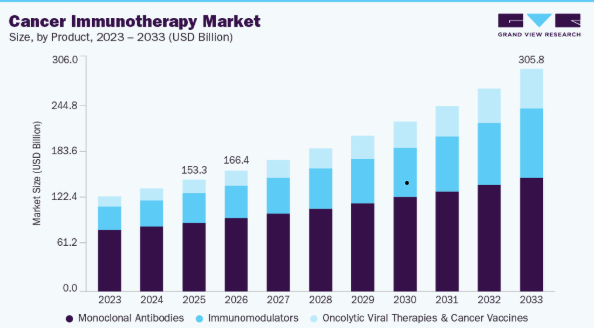
The global Cancer Immunotherapy Market was valued at USD 153.3 billion in 2025 and is projected to grow from USD 166.4 billion in 2026 to USD 305.8 billion by 2033, registering a CAGR of 9.0% from 2026 to 2033. North America dominated the global market with the largest revenue share of 43.3% in 2025, primarily driven by the increasing prevalence of cancer, continuous innovation in immuno-oncology, rising regulatory approvals for novel therapies, and growing investments in precision medicine.
Cancer immunotherapy has become one of the most transformative treatment approaches in oncology by harnessing the body's immune system to recognize and eliminate cancer cells. Unlike conventional chemotherapy and radiation therapy, immunotherapy provides targeted treatment with the potential for durable clinical responses across multiple cancer types. Continuous advancements in immune checkpoint inhibitors, monoclonal antibodies, adoptive cell therapies, cancer vaccines, and combination treatment strategies are significantly expanding therapeutic options for patients worldwide.
The growing global cancer burden, together with increasing awareness, earlier diagnosis, and expanding access to advanced oncology care, continues to create strong demand for innovative immunotherapy treatments across hospitals, cancer centers, and specialty clinics.
Rising Regulatory Approvals Accelerating Market Growth
The increasing approval of next-generation immunotherapies is one of the primary factors supporting market expansion.
For instance, in December 2024, AstraZeneca's Imfinzi (durvalumab) became the first and only approved treatment regimen for adult patients with limited-stage small cell lung cancer (LS-SCLC) whose disease had not progressed following platinum-based chemotherapy and radiation therapy. Such approvals continue expanding the clinical use of immunotherapy across additional cancer indications.
Patient-centric innovation is also driving adoption. In September 2024, the U.S. Food and Drug Administration (FDA) approved Tecentriq Hybreza, the first subcutaneous PD-(L)1 inhibitor. The formulation reduces treatment administration time to approximately 7 minutes, compared with 30–60 minutes for conventional intravenous infusion, while maintaining comparable safety and efficacy. Shorter administration times improve patient convenience, healthcare efficiency, and treatment accessibility.
Strategic Collaborations Strengthening Innovation
Strategic partnerships between biotechnology companies and pharmaceutical manufacturers continue accelerating the development of novel immunotherapies.
For example, in September 2023, Immatics and Moderna entered into a strategic collaboration to develop innovative oncology therapeutics by evaluating Immatics' investigational PRAME203 TCRT alongside Moderna's MARTE mRNA cancer vaccine.
Similarly, in August 2023, FBD Biologics Limited and Shanghai Henlius Biotech, Inc. announced a strategic collaboration focused on advancing next-generation immunotherapy development. These partnerships combine expertise in immunology, genomics, cellular therapies, and mRNA technology, supporting faster clinical development and expanding future treatment options.
Emerging Industry Trend: Personalized Immuno-Oncology
A major trend shaping the cancer immunotherapy market is the transition toward personalized immunotherapy. Advances in biomarker discovery, genomic sequencing, artificial intelligence, and companion diagnostics are enabling clinicians to identify patients most likely to benefit from specific immunotherapies. Personalized treatment selection is improving clinical outcomes while reducing unnecessary exposure to ineffective therapies. As precision oncology continues evolving, individualized immunotherapy approaches are expected to become increasingly important across multiple cancer indications.
Key Market Trends & Insights
Hospitals and Clinics Lead End-Use Adoption
- By end use, the hospitals & clinics segment accounted for 71.4% of global revenue in 2025.
- Rising cancer incidence, increasing diagnosis rates, expanding treatment availability, and the growing number of hospitals offering immunotherapy continue supporting segment growth.
- Specialized oncology centers are increasingly adopting advanced immunotherapy protocols supported by multidisciplinary treatment teams.
Monoclonal Antibodies Dominate Product Demand
- By product, the monoclonal antibodies segment accounted for 61.6% of market revenue in 2025.
- Ongoing investments in bispecific antibodies, antibody-drug conjugates (ADCs), and next-generation monoclonal antibody development continue expanding treatment opportunities.
- Improved efficacy, targeted action, and growing clinical evidence support widespread adoption across multiple cancer types.
Looking for more specific insights? Customize this report to suite your business needs
Hospital Pharmacies Maintain Leadership
- By distribution channel, the hospital pharmacy segment accounted for 55.0% of market revenue in 2025.
- Increasing hospitalization rates, greater utilization of biologic therapies, and specialized handling requirements continue driving demand through hospital pharmacy networks.
- Hospital-based administration also enables close patient monitoring during complex immunotherapy treatments.
Lung Cancer Represents the Largest Application
- By application, the lung cancer segment accounted for 18.1% of market revenue in 2025.
- Rising prevalence of lung cancer, expanding immunotherapy adoption, increasing awareness programs, and a strong pipeline of investigational therapies continue supporting market growth.
- Combination therapies integrating immunotherapy with chemotherapy and targeted therapies are improving treatment outcomes for eligible patients.
Regional Highlights
North America Leads the Global Market
- North America accounted for 43.3% of global market revenue in 2025.
- Strong healthcare infrastructure, extensive oncology research, favorable reimbursement systems, and rapid adoption of innovative biologic therapies continue driving regional leadership.
- High clinical trial activity and significant pharmaceutical investments further strengthen market expansion.
Asia Pacific Emerges as the Fastest-Growing Region
- Asia Pacific is projected to register the highest CAGR from 2026 to 2033.
- Rising cancer incidence, expanding healthcare infrastructure, growing government support, and increasing investments in oncology research are creating significant growth opportunities across the region.
United States Holds the Largest Country Market
- The U.S. accounted for the largest market share in 2025.
- According to the American Cancer Society Journal, approximately 2 million new cancer cases and 611,720 cancer deaths were estimated in the U.S. during 2024, highlighting the growing need for innovative cancer treatment options.
Market Size & Forecast
- Market Size (2025): USD 153.3 Billion
- Estimated Market Size (2026): USD 166.4 Billion
- Projected Market Size (2033): USD 305.8 Billion
- CAGR (2026–2033): 9.0%
- Largest Regional Market: North America (43.3% revenue share)
- Fastest-Growing Region: Asia Pacific
- Leading Country: United States
Innovation Driving the Future of Cancer Immunotherapy
The cancer immunotherapy industry continues to evolve through breakthroughs in immune checkpoint inhibitors, engineered T-cell therapies, personalized cancer vaccines, antibody-drug conjugates, and biomarker-guided treatment strategies. Artificial intelligence is increasingly supporting drug discovery, clinical trial optimization, patient stratification, and predictive biomarker identification, accelerating the development of next-generation immunotherapies.
Growing integration of genomics, molecular diagnostics, real-world evidence, and precision medicine is enabling more targeted treatment strategies that improve clinical outcomes while supporting value-based healthcare. These innovations are expected to expand the role of immunotherapy across both early-stage and advanced cancers.
Competitive Landscape
The global cancer immunotherapy market remains highly competitive, with leading pharmaceutical and biotechnology companies investing heavily in clinical research, product innovation, strategic collaborations, and regulatory expansion. Companies are actively pursuing combination therapies, novel immuno-oncology platforms, and expanded treatment indications to strengthen their competitive positions and address the growing global burden of cancer.
Increasing investments in precision oncology, cell therapy, mRNA technologies, and biomarker-driven treatment approaches are expected to further intensify innovation and reshape the future of cancer care.
Key Cancer Immunotherapy Companies
The following companies have been profiled in the global cancer immunotherapy market:
- Pfizer Inc.
- AstraZeneca
- Merck & Co., Inc.
- F. Hoffmann-La Roche Ltd.
- Bristol-Myers Squibb Company
- Novartis AG
- Lilly
- Johnson & Johnson Services, Inc.
- Immunocore, Ltd.
Conclusion
The global cancer immunotherapy market is witnessing sustained growth as rising cancer prevalence, expanding regulatory approvals, technological innovation, and increasing adoption of precision oncology continue transforming cancer treatment worldwide. The introduction of advanced monoclonal antibodies, immune checkpoint inhibitors, personalized therapies, and combination treatment regimens is improving survival outcomes while expanding therapeutic options across multiple cancer types.
Looking ahead, continued advances in artificial intelligence, biomarker discovery, genomic medicine, cell therapy, and personalized immuno-oncology are expected to further accelerate market expansion. As healthcare systems increasingly prioritize targeted, effective, and patient-centered cancer care, immunotherapy will remain one of the most important pillars of modern oncology over the coming decade.
Looking for a report customized to your requirements? Explore our Custom Research Offering
Grand View Research offers
- Focused market intelligence reports on specific geographies or high-growth segments
- Extended forecast timelines for long-term planning
- Competitor Benchmarking and Supply Chain Analysis
- Inclusion of regulatory and policy assessments
- Inclusion of custom data models, KPIs, or applications unique to your business
- Specific high-impact Data Decks and Tables to support effective decision making
And much more…

 English
 Arabic
 French
 Spanish
 Deutsch
 Turkish
 Dutch
Dutch
 Italiano
 Russian
 Romaian
 Portuguese (Brazil)
 Greek
Greek