
Vein Illuminator Market Analysis of Vascular Access Solutions
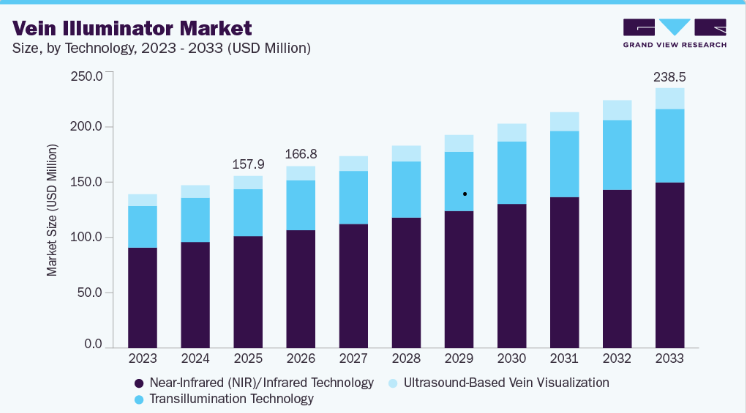
The global Vein Illuminator Market was valued at USD 157.9 million in 2025 and is projected to grow from USD 166.8 million in 2026 to USD 238.5 million by 2033, registering a CAGR of 5.2% from 2026 to 2033. North America dominated the global market with a 43.2% revenue share in 2025, supported by advanced healthcare infrastructure, increasing adoption of image-guided medical devices, and rising demand for improved vascular access technologies.
Market growth is primarily driven by the increasing prevalence of chronic diseases, obesity, venous disorders, and the growing number of minimally invasive aesthetic procedures. Healthcare providers are increasingly adopting vein illuminators to improve first-attempt venipuncture success, reduce patient discomfort, and enhance procedural efficiency across hospitals, outpatient clinics, emergency departments, and diagnostic centers.
The growing burden of chronic conditions such as diabetes, cancer, and obesity continues to increase the complexity of venous access. Patients with diabetes often experience vascular complications, including reduced vein elasticity, fragile blood vessels, and microvascular damage, making routine blood collection and intravenous access more challenging. According to the International Diabetes Federation (IDF), approximately 589 million people are currently living with diabetes worldwide, and this number is projected to reach 853 million by 2050, creating sustained demand for advanced vein visualization technologies.
Technological Advancements Improving Clinical Outcomes
Continuous innovation in medical imaging and visualization technologies is significantly improving the accuracy, efficiency, and usability of vein illuminators across healthcare settings.
Modern vein illuminator systems increasingly feature:
- Near-infrared (NIR) imaging technology
- High-resolution real-time vein visualization
- Portable and lightweight ergonomic designs
- Contact-free imaging systems
- Enhanced image contrast and depth detection
- Rechargeable battery-powered operation
- Integration with digital healthcare workflows
Near-infrared technology enables clinicians to visualize subcutaneous veins without direct skin contact, improving the success rate of venipuncture and intravenous cannulation while minimizing repeated needle insertions. These advancements contribute to better patient experiences, shorter procedure times, and improved clinical productivity.
Emerging Industry Trend: AI-Assisted Vein Visualization
An emerging trend within the vein illuminator market is the integration of artificial intelligence and advanced image processing technologies. AI-assisted visualization can enhance vein recognition, improve image clarity across different skin tones, and assist clinicians in identifying optimal puncture sites. As healthcare providers increasingly adopt digital health technologies, AI-enabled vein imaging is expected to become an important differentiator for next-generation vascular access devices.
Key Market Trends & Insights
Near-Infrared Technology Leads the Market
- By technology, the near-infrared (NIR)/infrared segment accounted for 64.9% of the market in 2025.
- Clinical validation demonstrating higher first-attempt venipuncture success continues to drive widespread adoption.
- NIR technology is particularly valuable for neonates, pediatric patients, elderly individuals, obese patients, and individuals with difficult venous access.
- Improved visualization enhances procedural efficiency while reducing patient discomfort and healthcare costs associated with repeated needle insertions.
IV Access & Venipuncture Remain the Largest Application
- By application, the IV access & venipuncture segment held the largest market share in 2025.
- Intravenous cannulation remains one of the most frequently performed clinical procedures worldwide.
- Increasing numbers of patients with difficult venous access continue to drive demand for reliable vein visualization devices.
- Vein illuminators support improved accuracy in blood collection, intravenous therapy, medication administration, and diagnostic testing.
Hospitals Continue to Dominate End Use
- By end use, the hospitals segment accounted for 54.5% of the market in 2025.
- Hospitals manage high patient volumes requiring intravenous access across emergency care, intensive care, surgery, oncology, pediatrics, and inpatient treatment.
- The increasing number of complex vascular access cases reinforces the need for advanced vein visualization technologies that improve workflow efficiency and patient safety.
Looking for more specific insights? Customize this report to suite your business needs
Regional Highlights
North America Leads Global Adoption
- North America accounted for 43.2% of global revenue in 2025, making it the largest regional market.
- Strong healthcare infrastructure, higher adoption of advanced medical technologies, and increasing investments in patient-centered care continue to support regional market leadership.
- Rising prevalence of diabetes, obesity, cancer, and vascular disorders further contributes to market growth.
Asia Pacific Emerges as the Fastest-Growing Region
- Asia Pacific is projected to register the highest CAGR between 2026 and 2033.
- Expanding healthcare infrastructure, growing hospital investments, rising healthcare expenditure, and increasing awareness of advanced vascular access technologies are driving regional demand.
- The growing burden of chronic diseases and expanding medical tourism are expected to create additional market opportunities.
United States Holds the Largest Country-Level Market
- The U.S. accounted for the largest market share in 2025.
- High procedural volumes, rapid adoption of innovative medical devices, and increasing emphasis on improving patient outcomes continue to support strong market demand.
Market Size & Forecast
- Market Size (2025): USD 157.9 Million
- Estimated Market Size (2026): USD 166.8 Million
- Projected Market Size (2033): USD 238.5 Million
- CAGR (2026–2033): 5.2%
- Largest Regional Market: North America
- Fastest-Growing Region: Asia Pacific
Growing Demand for Aesthetic and Vein Treatment Procedures
The increasing popularity of minimally invasive cosmetic and vascular treatments is creating new growth opportunities for the vein illuminator market. Procedures such as sclerotherapy, laser vein ablation, cosmetic injectables, and vascular laser treatments require precise visualization of superficial veins to improve treatment accuracy and patient safety.
In 2024, more than 38 million cosmetic surgery procedures were performed worldwide. According to the 2024 Procedural Statistics Report by the American Society of Plastic Surgeons, approximately 29% of U.S. patients aged 30–39 underwent minimally invasive skin procedures, including laser treatments, skin resurfacing, and sclerotherapy for varicose and spider veins. Furthermore, the 2024 Global Survey on Aesthetic/Cosmetic Procedures reported a 42.5% increase in cosmetic procedures over the past four years, including 20.5 million non-surgical procedures and 17.4 million surgical procedures performed in 2024. These trends continue to accelerate demand for advanced vein visualization technologies across dermatology, cosmetic surgery, and vascular care.
Competitive Landscape
The global vein illuminator market is characterized by continuous innovation focused on improving imaging accuracy, portability, clinician usability, and patient comfort. Manufacturers are investing in advanced infrared imaging technologies, ergonomic device designs, rechargeable portable systems, and expanded distribution partnerships to strengthen their competitive position.
Companies are also collaborating with hospitals, outpatient centers, and healthcare providers to increase clinical adoption while expanding their presence across emerging healthcare markets.
Key Vein Illuminator Companies
The following companies have been profiled in the global vein illuminator market:
- Christie Medical Holdings, Inc. (Acquired by CAREstream Group in June 2019)
- Hellovein
- Veinlite
- AccuVein, Inc.
- Venoscope
- ZD Medical Inc.
- Koninklijke Philips N.V.
- Infinium Medical, Inc.
- Vivolight
- VINO Optics
- GE Healthcare
Conclusion
The vein illuminator market is poised for steady growth as healthcare providers increasingly prioritize accurate vascular access, patient safety, and procedural efficiency. Rising cases of diabetes, obesity, cancer, and venous disorders, combined with the growing demand for minimally invasive aesthetic procedures, continue to strengthen the need for advanced vein visualization technologies.
Future market expansion will be supported by innovations in near-infrared imaging, artificial intelligence, portable medical devices, and digital healthcare integration. As hospitals and clinics focus on improving first-attempt venipuncture success and enhancing patient experiences, vein illuminators are expected to become an increasingly important component of modern vascular access and clinical care.
Looking for a report customized to your requirements? Explore our Custom Research Offering
Grand View Research offers
- Focused market intelligence reports on specific geographies or high-growth segments
- Extended forecast timelines for long-term planning
- Competitor Benchmarking and Supply Chain Analysis
- Inclusion of regulatory and policy assessments
- Inclusion of custom data models, KPIs, or applications unique to your business
- Specific high-impact Data Decks and Tables to support effective decision making
And much more…

 English
 Arabic
 French
 Spanish
 Portuguese
 Deutsch
 Turkish
 Dutch
Dutch
 Italiano
 Russian
 Portuguese (Brazil)
 Greek
Greek