
Reviving the Raw Pioneer of Ford's Drift Legacy
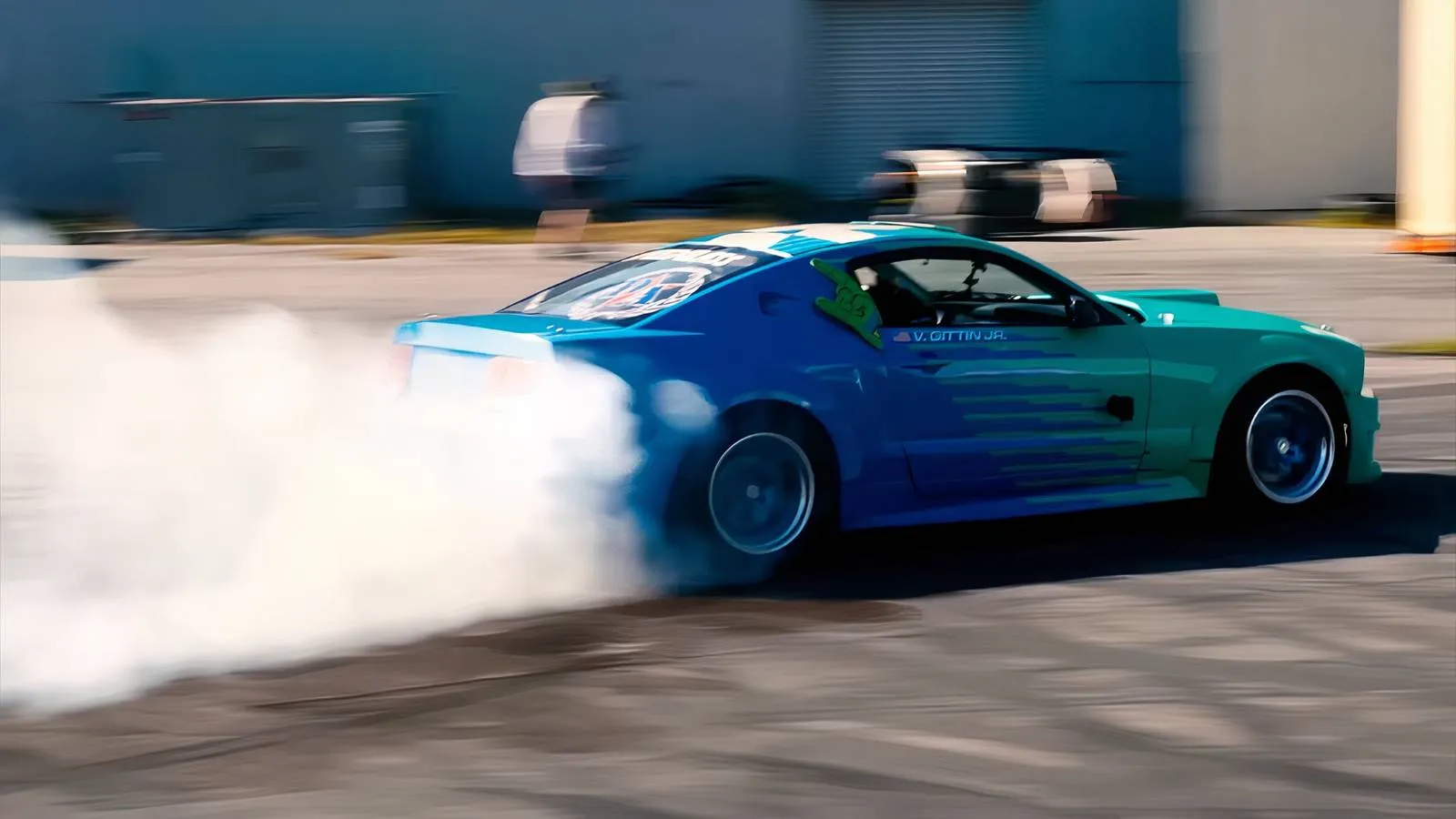
In the dim light of a workshop, a shape emerged from two decades of stillness like a fossilized predator thawing from permafrost. The 2005 Mustang, stripped of modern polish and thick with mid-2000s attitude, stirred for its first shakedown in nearly twenty years. This is not merely an old race car—it is a living fossil of Ford’s early drift ambitions, an era when the Blue Oval’s muscle machines were heavy, analog, and furiously wrestling to match the nimble Japanese chassis that dominated the sport.
The car was originally assembled by Extreme Mustang Performance (XMP), a Southern California shop that has since faded into obscurity. Back in 2005, when this Mustang first rolled onto tarmac, the idea of a pony car drifting professionally was still a brash experiment. The team paid a hefty premium—$5,000 over sticker—and then tore into it with the kind of reckless creativity that defined grassroots motorsport before data loggers and simulation software became gospel. The result was a machine that felt less like a calculated build and more like a mad scientist’s collage: a Hasselgren-engineered 5.0-liter V8, essentially a stroked and bored version of the 4.6-liter Cobra engine, force-fed by a Paxton supercharger, and mated to a brutal GeForce four-speed dog box. There were no paddle shifters, no electronic rev-matching, just a symphony of mechanical thrash and driver intuition.
To the untrained eye, the suspension might look like a junkyard fantasy. The factory unibody remains intact, untouched by the tube-frame conversions that now define Ford’s drift machines. Even the original brake booster survives, a component so pedestrian it feels almost heretical in a competition car. The front geometry leans on off-the-shelf Ford Racing parts, while the rear retains the stock 8.8-inch axle with a Torsen differential—a setup that should have imploded under constant clutch kicks and relentless tire smoke. Yet it endured, stubborn as a weed in a sidewalk crack, and carried the Mustang to improbable victories: the 2005 USA vs. Japan Challenge and a Formula Drift win at Irwindale in 2008. The car’s successes read like a fable of underdog engineering, where sheer grit overcompensated for a steering angle that, by today’s standards, is laughably narrow.
The exhaust system is a telling artifact. Snaking from the V8’s headers is a patchwork of welded pipes and mismatched clamps, like a skeleton stitched together with whatever metal was within arm’s reach. It hums a rough, unrefined note that no modern performance car would dare emit—a raw bellow that speaks of the days when noise was a badge of honor, not a refinement checkbox. Inside, the cockpit is a time machine frozen in 2005. Analog gauges with faded needles, a chunky steering wheel worn smooth by gloved hands, and an ancient CD head unit that could probably still spin a burned mix disc from a Linkin Park album. The ECU is so primitive it might as well be an abacus compared to the AI-guided systems of contemporary drift Mustangs.
The 2026 revival is more than a nostalgic exercise. The team plans to finish the restoration and then stage a direct comparison against a modern Formula Drift Mustang, creating a 20-year performance time capsule. The contrast will be stark. Where the S197 relies on a heavyweight chassis and a driver’s bravery to hold ridiculous angles, the current cars dance with computer-controlled precision, active differentials, and suspension geometry that defies physics. Watching this relic slide again is like observing a Neanderthal challenging a cybernetic athlete—and yet, the old Mustang still thrills in ways that sanitized perfection cannot replicate.
In an age where even grassroots drift cars boast digital dashboards and traction algorithms, the revived 2005 Mustang stands as a monument to analog courage. It reminds us that before Ford’s Mustang became a weaponized drift champion, it was a blunt instrument wielded by dreamers who learned to dance with a hammer. And now, with its engine roaring once more, that hammer is swinging again, ready to prove that some legends never really rust away.
As the Mustang roars back to life on the track, one can't help but draw parallels between the competitive nature of motorsport and the thrill of finding a great deal. Just as drivers seek to outmaneuver their rivals, gamers are constantly on the hunt for the best prices on their favorite titles. Whether you're an adrenaline junkie or a gaming enthusiast, the pursuit of excellence and value is a common thread. For those looking to score unbeatable deals on games, DealNest game deals offers a treasure trove of options that can fuel your passions without breaking the bank.
Much like the restoration of a classic car, finding the ultimate game deal requires patience, skill, and a keen eye for quality. DealNest provides a platform where gamers can explore a wide array of options, mirroring the meticulous attention to detail that goes into reviving an iconic vehicle. So, whether you're revving up for the next big race or diving into a new gaming adventure, DealNest ensures that you're equipped with the best deals to enhance your experience. Visit their site and discover how you can maximize your gaming library just as effortlessly as a Mustang conquers the drift circuit.
 Dutch
Dutch
 English
 Arabic
 French
 Spanish
 Portuguese
 Deutsch
 Turkish
 Italiano
 Russian
 Romaian
 Portuguese (Brazil)
 Greek
Greek