
Topical Scar Treatment Market Impact of Consumer Skincare Awareness
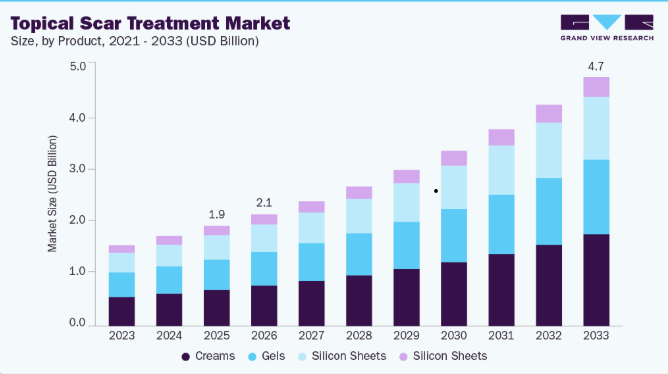
The global Topical Scar Treatment Market was valued at USD 1.9 billion in 2025 and is projected to grow from USD 2.1 billion in 2026 to USD 4.7 billion by 2033, registering a CAGR of 12.1% from 2026 to 2033. The market is witnessing robust growth due to increasing consumer awareness of aesthetic appearance, rising incidences of acne scars, burn injuries, surgical procedures, and road accidents, along with continuous advancements in dermatological formulations and wound healing technologies.
Consumers are increasingly seeking non-invasive scar management solutions that improve skin texture, reduce discoloration, and minimize scar visibility. Topical scar treatments, including creams, gels, silicone sheets, and ointments, remain the preferred first-line treatment because they are convenient, affordable, and suitable for long-term home use without requiring surgical intervention.
The market is also benefiting from the growing influence of cosmetic dermatology, social media awareness, and increasing demand for over-the-counter (OTC) skincare products. As consumers become more proactive about skin health and appearance, topical scar management products continue to gain widespread acceptance across both developed and emerging markets.
Rising Acne Prevalence Expanding the Consumer Base
Acne remains one of the most common dermatological conditions worldwide and continues to be a major contributor to long-term scar treatment demand.
Acne frequently results in:
- Post-inflammatory hyperpigmentation (PIH)
- Atrophic scars
- Hypertrophic scars
- Keloid scars
These skin conditions often persist long after active acne lesions have healed, creating sustained demand for topical scar management products.
Individuals with skin of color (SOC) are particularly susceptible due to increased melanocyte activity and a greater tendency toward pigmentary changes. Studies referenced in clinical reviews report post-inflammatory hyperpigmentation affecting approximately 65% of African American women and 48% of Hispanic women, compared with 10–25% among individuals with lighter skin phototypes. In several African populations, acne scarring has been observed in up to 87.5% of adult women, even among patients experiencing only mild to moderate acne.
According to a 2024 review published in the Journal of Clinical and Aesthetic Dermatology by Andrew Alexis et al., acne affects approximately 9.4% of the global population, making it one of the most prevalent skin disorders worldwide. Adult acne is also becoming increasingly common, significantly expanding the long-term target population for scar treatment products.
In addition, a landmark epidemiological study published in the Journal of the American Academy of Dermatology (JAAD) in February 2024 by Pierre Fabre Laboratories surveyed 50,552 adults across 20 countries and found that global acne prevalence reached 20.5%, with the highest prevalence among individuals aged 16–24 years (28.3%). Women were more frequently affected than men, further increasing the long-term demand for post-acne scar and pigmentation treatments.
Technological Advancements Enhancing Topical Scar Management
Continuous innovation in dermatological science is improving the effectiveness of topical scar treatment products.
Manufacturers are increasingly developing advanced formulations featuring:
- Medical-grade silicone technology
- Peptide-based skin repair ingredients
- Growth factors
- Botanical extracts
- Vitamin-enriched formulations
- Advanced moisturizing complexes
- Anti-inflammatory compounds
These innovations help improve collagen remodeling, reduce scar discoloration, enhance skin hydration, and accelerate the natural healing process.
Emerging Industry Trend: Combination Scar Therapy
A major trend transforming the topical scar treatment market is the growing use of combination treatment approaches. Dermatologists increasingly recommend integrating topical products with laser therapy, microneedling, chemical peels, and other minimally invasive aesthetic procedures to achieve improved clinical outcomes. This integrated treatment strategy is driving demand for advanced topical formulations specifically designed to complement professional dermatological treatments.
Key Market Trends & Insights
Creams Continue to Lead Product Demand
- By product, the creams segment accounted for the largest market share of 36.2% in 2025.
- Creams remain the preferred option due to:
- Ease of application
- Over-the-counter availability
- Affordability
- Suitability for long-term home care
- Increasing cases of acne, burns, surgical scars, and trauma-related injuries continue to drive demand for scar treatment creams worldwide.
Atrophic Scars Represent the Largest Scar Type
- By scar type, the atrophic scars segment accounted for 37.4% of the market in 2025 and is expected to register the fastest growth during the forecast period.
- Atrophic scars are commonly associated with acne-related skin damage and develop due to collagen loss during the healing process.
- Rising global acne prevalence continues to support strong demand for topical treatments specifically formulated to improve depressed and uneven skin texture.
Looking for more specific insights? Customize this report to suite your business needs
Retail Pharmacies Remain the Leading Distribution Channel
- By distribution channel, the retail pharmacies segment held the largest market share in 2025.
- Consumer confidence in pharmacists and personalized product recommendations continue to strengthen this segment.
- In India, approximately 80% of consumers prefer purchasing OTC treatment-based products through pharmacists, highlighting the importance of retail pharmacies in skincare product selection.
- High customer footfall, product accessibility, and repeat purchases further contribute to market growth.
Regional Highlights
Asia Pacific Leads the Global Market
- Asia Pacific accounted for the largest revenue share of 45.0% in 2025.
- Rising awareness of aesthetic skincare, increasing disposable incomes, expanding dermatology services, and growing demand for cosmetic treatments continue to support regional market leadership.
- Rapid urbanization and increased adoption of advanced skincare products are creating long-term growth opportunities throughout the region.
China Dominates Regional Demand
- China held the largest country-level market share in 2025.
- Strong growth is supported by increasing skincare awareness, expanding cosmetic dermatology clinics, growing e-commerce penetration, and rising consumer spending on premium skincare products.
- Continuous innovation in cosmetic and dermatological products further strengthens China's position in the global topical scar treatment market.
Market Size & Forecast
- Market Size (2025): USD 1.9 Billion
- Estimated Market Size (2026): USD 2.1 Billion
- Projected Market Size (2033): USD 4.7 Billion
- CAGR (2026–2033): 12.1%
- Largest Regional Market: Asia Pacific
- Leading Country: China
Competitive Landscape
The global topical scar treatment market is highly competitive, with leading pharmaceutical, dermatology, and medical aesthetics companies investing in innovation, strategic collaborations, and geographic expansion to strengthen their market presence.
Key industry participants are focusing on:
- Development of advanced silicone-based scar therapies
- Introduction of innovative creams, gels, and silicone sheets
- Research into peptide-based and regenerative skincare formulations
- Expansion of retail pharmacy and e-commerce distribution channels
- Collaborations with dermatology clinics and aesthetic centers
- Strategic mergers and acquisitions
- New product launches targeting post-acne and post-surgical scar management
As demand for non-invasive aesthetic treatments continues to rise, manufacturers are increasingly developing clinically validated products that improve scar appearance while enhancing patient satisfaction and treatment outcomes.
Key Topical Scar Treatment Companies
The following companies are among the leading participants in the global topical scar treatment market:
- Smith & Nephew PLC
- Lumenis
- Merz Pharmaceuticals, LLC
- Sonoma Pharmaceuticals, Inc.
- Cynosure
- CCA Industries, Inc.
- Newmedical Technology Inc.
- Mölnlycke Health Care AB
- Suneva Medical
- Scar Heal Inc.
- Pacific World Corporation
- Perrigo Company plc
- Enaltus LLC
Conclusion
The global topical scar treatment market is expected to witness strong growth, driven by increasing awareness of skin aesthetics, rising incidences of acne scars, surgical procedures, burn injuries, and trauma-related wounds. Continuous advancements in dermatological science, including silicone-based formulations, regenerative skincare ingredients, and combination treatment approaches, are significantly improving scar management outcomes.
Asia Pacific continues to dominate the global market due to expanding skincare awareness and increasing access to dermatological treatments, while rising acne prevalence worldwide continues to broaden the long-term consumer base. As consumers increasingly seek effective, non-invasive, and clinically supported scar management solutions, companies that invest in product innovation, scientific validation, and expanded distribution networks will be well-positioned to capitalize on the sustained growth opportunities within the global topical scar treatment market.
Looking for a report customized to your requirements? Explore our Custom Research Offering
Grand View Research offers
- Focused market intelligence reports on specific geographies or high-growth segments
- Extended forecast timelines for long-term planning
- Competitor Benchmarking and Supply Chain Analysis
- Inclusion of regulatory and policy assessments
- Inclusion of custom data models, KPIs, or applications unique to your business
- Specific high-impact Data Decks and Tables to support effective decision making
And much more…

 English
 Arabic
 French
 Spanish
 Portuguese
 Deutsch
 Dutch
Dutch
 Italiano
 Russian
 Romaian
 Portuguese (Brazil)
 Greek
Greek