
Global Upcycled & Sustainable Vitamin C Market Report Forecasts USD 1.73 Billion Value by 2036
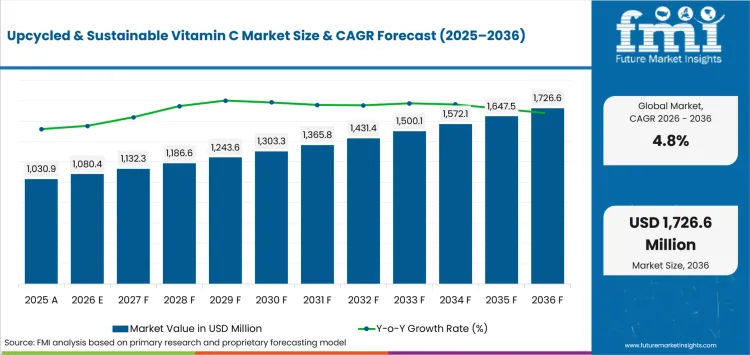
NEWARK, Del., August 17, 2026 — The global Upcycled & Sustainable Vitamin C Market is valued at USD 1,080.4 million in 2026 and is projected to reach USD 1,726.6 million by 2036, expanding at a CAGR of 4.8% between 2026 and 2036, according to Future Market Insights (FMI). The market is being shaped by rising demand for vitamin C ingredients that combine reliable potency with traceable sourcing, resource-efficiency claims, and suitability for food, beverage, and dietary supplement applications.
For procurement leaders, formulation teams, and product innovation professionals, the outlook highlights a growing opportunity for suppliers that can demonstrate consistent vitamin potency, source traceability, contaminant controls, and regulatory documentation across repeated commercial production lots.
👉 Get Detailed Market Forecasts, Competitive Benchmarking, and Pricing Trends:
Key Upcycled & Sustainable Vitamin C Market Highlights
• Market Size (2026): USD 1,080.4 Million
• Forecast Market Size (2036): USD 1,726.6 Million
• Forecast Period: 2026–2036
• CAGR (2026–2036): 4.8%
• Leading Source (2026): Fermentation – 50.8% share
• Leading Form (2026): Powder – 40.4% share
Why Is the Upcycled & Sustainable Vitamin C Market Growing?
• Demand for sustainable vitamin C is increasing as food and supplement manufacturers seek ingredients that deliver reliable potency across repeated production lots and diverse applications.
• Fermentation is expected to account for 50.8% of source revenue in 2026, supported by controlled purification, repeatable release testing, and scalability for commercial orders.
• Upcycled and botanical recovery routes are gaining attention as manufacturers seek traceable resource claims, although variable botanical composition and source-specific authorization requirements remain important qualification considerations.
• Growing interest in clean-label ingredients and food-waste recovery is creating opportunities for vitamin C suppliers that can provide stable potency, complete application records, traceable mass balances, and contaminant controls.
Analyst Viewpoint
“Upcycled vitamin C earns a premium through evidence that links feedstock origin with stable assay performance across repeated commercial lots. Botanical recovery needs detailed contaminant controls; fermentation producers must prove that energy use and intermediate chemistry support the stated resource benefit. Strong programs test potency and authorization separately and define environmental boundaries for each production route and customer application.”
— Nandini Roy Choudhury, Principal Analyst, Future Market Insights
Which Segment Leads Market Share?
By Source
Fermentation leads the source segment with a 50.8% share in 2026, reflecting the advantages of controlled purification, repeatable release testing, and scalability across large commercial orders. Fermented ingredients retain an important position where manufacturers require consistent vitamin potency and clearly defined customer specifications.
By Form
Powder is projected to represent around 40.4% of the market by form in 2026, supported by its suitability across food, beverage, supplement, and nutraceutical formulations. Powdered vitamin C formats also provide manufacturers with flexibility in formulation and dosage management.
By Sustainability and Ingredient Qualification
Demand increasingly depends on stable vitamin potency, traceable resource claims, contaminant controls, and regulatory documentation. Upcycled ingredients derived from food-waste recovery require documented mass balances and appropriate safety controls, while botanical sources may face additional authorization requirements depending on origin and intended application.
👉 Access the Complete Report in PDF Format: https://www.futuremarketinsights.com/reports/brochure/rep-gb-34372
Market Dynamics
Drivers
• Rising demand for sustainable and traceable vitamin C ingredients across food, beverage, and dietary supplement applications.
• Fermentation-based production provides controlled purification and repeatable release testing, supporting commercial-scale procurement.
• Growing adoption of clean-label and resource-efficient ingredient strategies is increasing interest in upcycled vitamin C solutions.
• Expanding nutrition production in India and China is creating additional opportunities for sustainable vitamin C suppliers.
Restraints
• Variable botanical composition can make potency consistency and ingredient qualification more challenging.
• Source-specific authorization requirements can slow commercialization of recovered or novel vitamin C ingredients.
• Environmental claims require clear boundaries, traceable sourcing, and evidence supporting resource-efficiency benefits.
• Regulatory documentation and intended-use evidence can increase qualification requirements in highly regulated markets.
Trends
• Fermentation is strengthening its position through controlled processing and repeatable vitamin potency.
• Food-waste recovery programs are increasingly incorporating traceable mass balances and contaminant controls.
• Clean-label positioning is translating into commercial opportunities when suppliers can demonstrate stable potency and complete application records.
• Ingredient manufacturers are placing greater emphasis on environmental boundaries and documented sustainability claims for individual production routes.
Regional and Country Outlook
India and China are positioned for faster growth as nutrition production expands and domestic manufacturing capacity increases. The United States and Europe place greater emphasis on intended-use evidence, source documentation, and regulatory qualification during ingredient approval.
• India and China: Growth is supported by expanding nutrition manufacturing and domestic production capabilities.
• United States: Ingredient qualification increasingly depends on documented intended use, potency, and source information across regulated food and supplement applications.
• Europe: Regulatory pathways and detailed product and production evidence remain important for ingredients whose source or processing history differs from established ascorbic acid.
• Global Outlook: Country performance depends not only on market growth rates but also on regulatory pathways, technical support, source traceability, and consistency of vitamin potency.
Competitive Landscape
Key players in the Upcycled & Sustainable Vitamin C Market include:
• dsm-firmenich
• CSPC Pharmaceutical Group
• Northeast Pharmaceutical
• Symrise
• Givaudan
• Döhler
• Nexira
• Kemin
These companies are positioned across vitamin C production, ingredient development, botanical sourcing, functional ingredient solutions, and specialty formulation support. Competitive differentiation increasingly depends on consistent assay performance, source traceability, regulatory documentation, and the ability to meet sustainability requirements across customer applications.
👉 Read the Upcycled & Sustainable Vitamin C Market Complete Report:
FAQ: Upcycled & Sustainable Vitamin C Market
What is the projected size of the Upcycled & Sustainable Vitamin C Market by 2036?
The market is projected to reach USD 1,726.6 million by 2036, up from USD 1,080.4 million in 2026.
What is the expected CAGR of the market?
The market is forecast to expand at a 4.8% CAGR between 2026 and 2036.
Which source leads the market?
Fermentation leads the source segment with a 50.8% share in 2026.
Which form leads the market?
Powder is projected to account for approximately 40.4% share by form in 2026.
What is driving growth in the market?
Growth is driven by increasing demand for sustainable and traceable vitamin C ingredients, reliable potency, clean-label formulations, fermentation-based production, and resource-recovery initiatives.
What are the key challenges facing the market?
Variable botanical composition, source-specific authorization requirements, contaminant controls, and the need for substantiated sustainability and resource-efficiency claims remain key challenges.
Which companies are profiled in the market?
Key companies include dsm-firmenich, CSPC Pharmaceutical Group, Northeast Pharmaceutical, Symrise, Givaudan, Döhler, Nexira, and Kemin.
Related Report
https://www.linkedin.com/pulse/harissa-sauce-market-size-reach-usd-kj1ic/
https://www.linkedin.com/pulse/demand-frozen-egg-united-kingdom-market-wzqqc/
About Future Market Insights (FMI)
Future Market Insights, Inc. provides actionable market intelligence and consulting services across global industries. FMI delivers market research, competitive intelligence, and strategic insights designed to help organizations identify emerging opportunities, evaluate market dynamics, and make informed business decisions.
Media Contact
Rahul Singh
AVP – Marketing and Growth Strategy
Future Market Insights, Inc.
Phone: +91 8600020075
Email (Sales): [email protected]
Email (Media): [email protected]
Web: www.futuremarketinsights.com

 Arabic
 French
 Spanish
 Portuguese
 Deutsch
 Turkish
 Dutch
Dutch
 Italiano
 Russian
 Romaian
 Portuguese (Brazil)
 Greek
Greek