
Hydrophilic Coatings Market Growth Fueled by Minimally Invasive Procedures
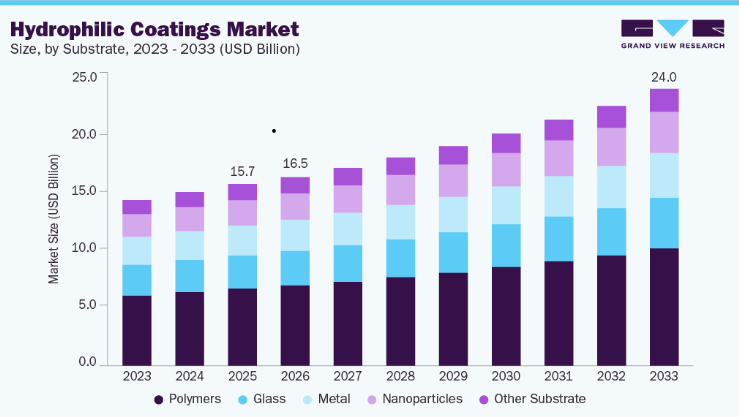
The global Hydrophilic Coatings Market size was valued at USD 15.7 billion in 2025 and is projected to grow from USD 16.5 billion in 2026 to USD 24.0 billion by 2033, registering a CAGR of 5.6% from 2026 to 2033. North America accounted for the largest revenue share of 34.4% in 2025, driven by the strong presence of medical device manufacturers, advanced healthcare infrastructure, and increasing adoption of minimally invasive procedures.
The market is primarily fueled by the growing demand for high-performance surface technologies that improve lubrication, reduce friction, and enhance durability across medical, industrial, optical, and electronic applications. Hydrophilic coatings create water-attracting surfaces that significantly improve product functionality without requiring manufacturers to redesign the underlying material. This capability has made these coatings increasingly valuable for original equipment manufacturers (OEMs) seeking to improve product performance while maintaining manufacturing efficiency and controlling production costs.
One of the strongest growth drivers is the rapid expansion of minimally invasive healthcare procedures. Medical devices such as catheters, guidewires, sheath introducers, and endoscopic instruments increasingly rely on hydrophilic coatings to reduce insertion force, improve navigation through blood vessels, and enhance patient comfort. Healthcare providers continue to prioritize devices that deliver consistent lubricity throughout lengthy procedures while maintaining coating adhesion after sterilization and long-term storage. As cardiovascular, neurovascular, and urological procedures become more sophisticated, manufacturers are investing heavily in next-generation coating technologies capable of delivering uniform performance even on highly complex device geometries.
Beyond healthcare, hydrophilic coatings are gaining significant traction across optics, electronics, automotive, and industrial manufacturing. Camera modules, automotive sensors, displays, mirrors, and optical lenses increasingly utilize hydrophilic coatings to prevent fogging, improve visibility, and maintain image clarity under varying environmental conditions. The growing deployment of advanced driver assistance systems (ADAS), industrial automation, and precision sensing technologies is further increasing demand for anti-fog and self-wetting coating solutions that improve long-term operational reliability.
The industry is also benefiting from increasing emphasis on sustainable manufacturing and lifecycle performance. Industrial users are shifting purchasing priorities beyond initial coating costs toward solutions that reduce maintenance requirements, minimize cleaning chemical consumption, and improve product longevity. In response, coating manufacturers are introducing environmentally friendly technologies, including water-based formulations and UV-curable coating systems, which reduce emissions while improving production efficiency. These sustainable innovations align with broader ESG initiatives adopted across healthcare, automotive, and manufacturing industries.
Technological innovation continues to reshape the competitive landscape of the hydrophilic coatings industry. Companies are developing thinner coating layers that maintain excellent lubricity without altering component dimensions, while advanced surface preparation techniques improve adhesion across polymer and metal substrates. Integration of precision coating equipment, automated quality inspection, and cleanroom-compatible manufacturing processes is enabling suppliers to meet increasingly stringent quality standards required by medical device OEMs. Additionally, partnerships between coating formulators and contract coating specialists are accelerating commercialization by simplifying regulatory validation and reducing product development timelines.
Looking ahead, the market is expected to witness increasing adoption of multifunctional coating technologies that combine hydrophilic performance with antimicrobial, anti-fouling, and wear-resistant properties. These next-generation solutions are expected to create new opportunities across advanced medical devices, wearable electronics, biosensors, diagnostic equipment, and industrial automation systems. As regulatory standards continue to emphasize product safety, durability, and manufacturing consistency, suppliers capable of delivering scalable, validated, and high-performance coating platforms are expected to strengthen their competitive position.
Key Market Trends & Insights
By Substrate
- Polymers segment held the largest market share of 42.5% in 2025, largely due to its extensive use across medical devices, optical products, and industrial components. Polymer substrates such as polyurethane, polyethylene, and polyamide are widely adopted because they provide flexibility, durability, and compatibility with hydrophilic coating chemistries.
By Application
- Medical devices and equipment segment held the largest market share of 41.9% in 2025, reflecting strong demand from minimally invasive medical procedures. Hydrophilic coatings are widely applied on catheters, guidewires, sheath introducers, and endoscopic devices to reduce friction during insertion and navigation within blood vessels.
Looking for more specific insights? Customize this report to suite your business needs
Regional Highlights
- Largest regional market: North America (34.4% revenue share, 2025)
- Fastest-growing regional market: Asia Pacific
- By country: China held the largest market share in 2025.
Growing healthcare investments, expanding medical device manufacturing, and increasing industrial automation across China, Japan, South Korea, and India are expected to accelerate hydrophilic coating adoption throughout the Asia Pacific region during the forecast period.
Market Size & Forecast
- Market Size (2025): USD 15.7 Billion
- Estimated Market Size (2026): USD 16.5 Billion
- Projected Market Size (2033): USD 24.0 Billion
- CAGR (2026–2033): 5.6%
Key Hydrophilic Coatings Company Insights
The hydrophilic coatings market remains highly innovation-driven, with leading manufacturers focusing on advanced material science, coating durability, regulatory compliance, and strategic collaborations with medical device OEMs. Companies continue investing in research and development to enhance lubricity, improve substrate compatibility, and expand applications beyond healthcare into industrial and optical markets.
Surmodics Inc. is a leading developer of advanced surface modification technologies that improve the performance of minimally invasive medical devices. The company's hydrophilic and lubricious coating platforms enhance device maneuverability, reduce friction, and improve procedural efficiency across cardiovascular, vascular, and diagnostic applications. Continuous innovation and strong partnerships with medical device manufacturers reinforce its leadership position in the market.
Hydromer Inc. specializes in hydrophilic polymer coating technologies designed to improve wettability, reduce friction, and enhance long-term surface performance. Its coating solutions are widely used across medical devices and industrial applications where reliable adhesion, durability, and controlled fluid interaction are essential. The company continues to expand its technology portfolio to address evolving customer requirements across healthcare and advanced manufacturing sectors.
Key Hydrophilic Coatings Companies
- Surmodics Inc.
- Hydromer Inc.
- Biocoat Inc.
- AST Products Inc.
- Aculon Inc.
- Surface Solutions Group LLC
- DSM Biomedical (dsm-firmenich)
- Tokyo Ohka Kogyo Co., Ltd.
- BioInteractions Ltd.
- Covalon Technologies Ltd.
Conclusion
The hydrophilic coatings market is positioned for steady long-term growth as demand increases for advanced surface technologies that improve performance, safety, and durability across healthcare, electronics, automotive, and industrial applications. Rising adoption of minimally invasive medical procedures, expanding use of optical sensors and imaging systems, and continuous innovation in sustainable coating chemistries are reshaping market dynamics. Furthermore, advancements in UV-curable formulations, cleanroom manufacturing, multifunctional coatings, and precision application technologies are enabling manufacturers to meet increasingly stringent performance and regulatory requirements. As industries continue to prioritize product reliability, operational efficiency, and sustainability, hydrophilic coatings are expected to play an increasingly critical role in next-generation device manufacturing and high-value industrial applications through 2033.
Looking for a report customized to your requirements? Explore our Custom Research Offering
Grand View Research offers
- Focused market intelligence reports on specific geographies or high-growth segments
- Extended forecast timelines for long-term planning
- Competitor Benchmarking and Supply Chain Analysis
- Inclusion of regulatory and policy assessments
- Inclusion of custom data models, KPIs, or applications unique to your business
- Specific high-impact Data Decks and Tables to support effective decision making
And much more…

 Arabic
 French
 Spanish
 Portuguese
 Deutsch
 Turkish
 Dutch
Dutch
 Italiano
 Russian
 Romaian
 Portuguese (Brazil)
 Greek
Greek